About Haematopus finschi G.H.Martens, 1897
Overall Appearance
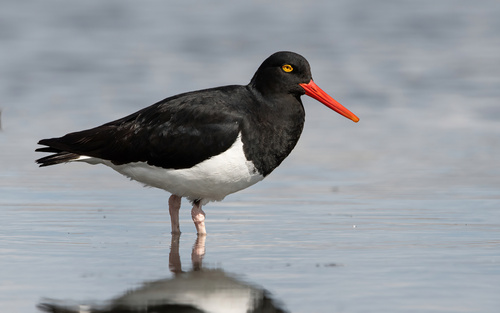
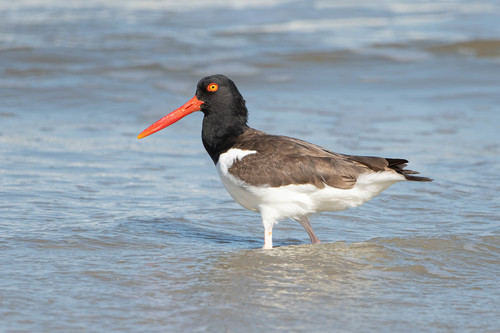
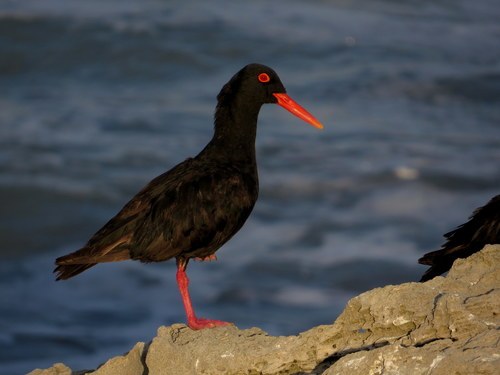
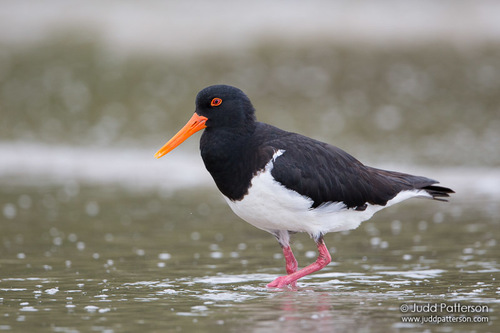
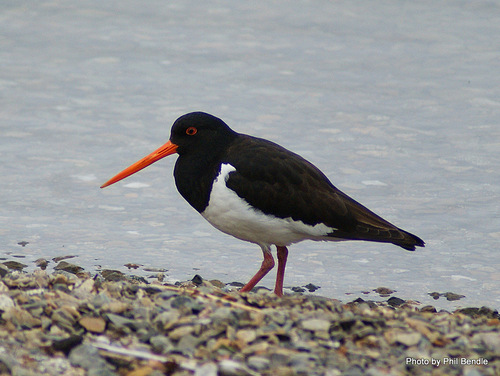
Description: The South Island oystercatcher is easily recognizable as a pied oystercatcher, a large wading bird with distinctive black and white plumage, a long red-orange bill, and red legs.
Distinction from Variable Oystercatcher
It can be told apart from the pied morph of the variable oystercatcher by its white lower back, more white coloration on the wing, and a black-and-white demarcation line that sits further forward on the breast.
Distinction from Australian Pied Oystercatcher
Compared to Australia’s pied oystercatcher, the South Island oystercatcher has a longer bill, shorter legs, and a pointed rather than square demarcation line for the white area on the forward part of its back.
Size and Weight
This species measures 46 cm in length, has a wingspan of 80 to 86 cm, and weighs approximately 550 g.
Distribution Range
Distribution and habitat: The South Island oystercatcher is endemic to New Zealand.
Breeding and Movement Patterns
It breeds inland on the country’s South Island, after which most of the population moves to estuaries and harbors on the North Island.
Vagrant Records
It has occasionally been recorded as a vagrant on Norfolk Island, Lord Howe Island, and the eastern coast of mainland Australia.
Breeding Habitats
Its breeding habitats include braided river systems, open paddocks, cultivated land, lake beaches, subalpine tundra, and herb fields.
Non-breeding Habitats
Non-breeding habitats include coastal estuaries, bays, beaches, sand flats, and intertidal mudflats.
Primary Diet Components
Food: This oystercatcher feeds mostly on mollusks and worms.
Key Prey Species
The New Zealand cockle, Austrovenus stutchburyi, is a major food source for the species.
Feeding Consumption Rate
It has been estimated that a single individual South Island oystercatcher can eat around 200,000 of these cockles in one year.