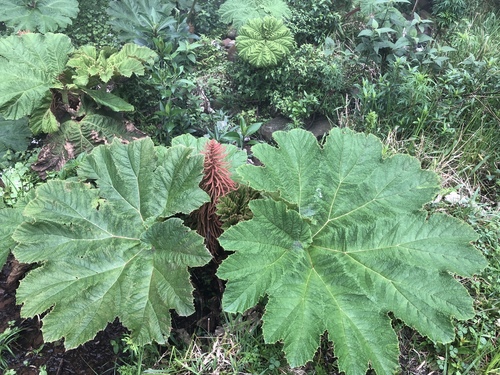
About Gunnera manicata Linden
Nomenclature and Common Name
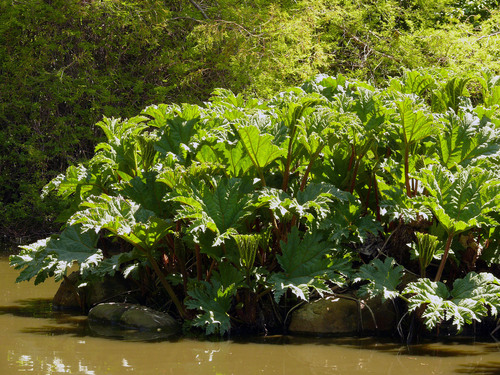
Gunnera manicata Linden, commonly called giant rhubarb, is a large, clump-forming herbaceous perennial that reaches 2.5 meters (8 feet) tall and spreads 4 meters (13 feet) or more wide.
Leaf Size
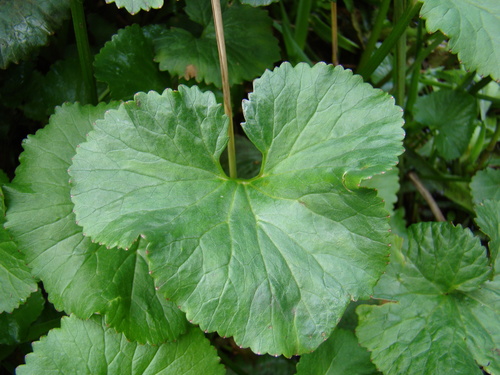
This species produces impressively large leaves: leaves with diameters well over 1.2 meters (3 feet 11 inches) are common, and a mature plant can have an overall leaf spread of 3 by 3 meters (10 feet by 10 feet). The largest recorded leaf of this species reached up to 3.4 meters (11 feet) in width.
Congeneric Size Comparison
It is the largest Gunnera species by size, though it is not the tallest, a distinction that belongs to Gunnera masafuerae.
Leaf and Stalk Morphology
Small spikes cover the underside of its leaves and its entire stalk.
Flower and Fruit Characteristics
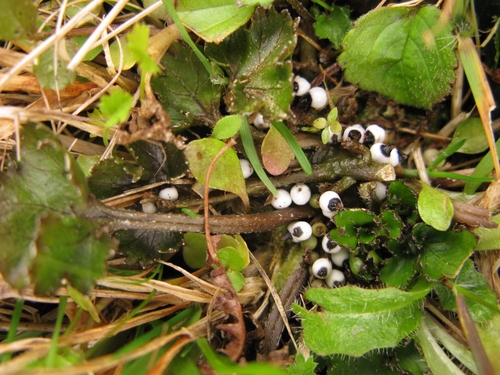
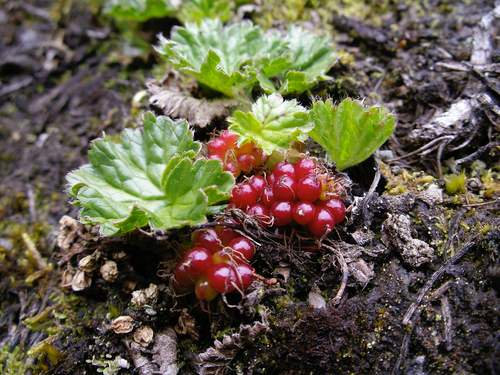
In early summer, it produces tiny red-green dimerous flowers arranged in conical branched panicles, which are followed by small, spherical fruit.
Symbiotic Relationship
Like most gunneras, G. manicata forms a symbiotic relationship with certain blue-green algae that fix nitrogen to provide for the plant.
Taxonomic Relationship to True Rhubarb
Despite its common name giant rhubarb, it is not closely related to true rhubarb.
Genus Etymology
The genus is named after Johan Ernst Gunnerus, a Norwegian bishop and naturalist who also named and formally described the basking shark.
Native Range and Traditional Use
G. manicata is native to the Serra do Mar mountains of coastal Santa Catarina and Rio Grande do Sul states, Brazil, where local communities use it in traditional medicine to treat sexually transmitted diseases.
Cultivated Identity Misclassification in Western Europe
Most cultivated and feral plants growing in Western Europe that were previously identified as G. manicata have actually been replaced, fully or largely, by the hybrid Gunnera × cryptica.
Ornamental Cultivation in UK and Ireland
Giant rhubarb became widely cultivated as an ornamental garden plant in the United Kingdom and Ireland, grown primarily to showcase its massive leaves.
Cultivation Requirements
It grows best in damp conditions, such as near garden ponds, and it is intolerant of cold, wet winter conditions.
Hybrid Identification Confirmation
In 2022, the Royal Horticultural Society confirmed that most plants cultivated as G. manicata in the region were actually Gunnera × cryptica, a hybrid of G. manicata and the highly invasive Gunnera tinctoria.
UK Regulatory Status
In December 2023, the UK Department for Environment, Food and Rural Affairs banned Gunnera × cryptica: it may no longer be sold or cultivated in the UK, and gardeners who already have the plant must prevent it from spreading.