About Guazuma ulmifolia Lam.
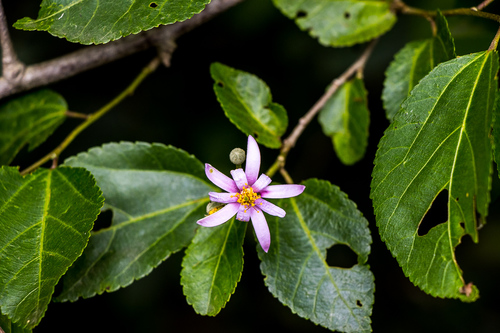
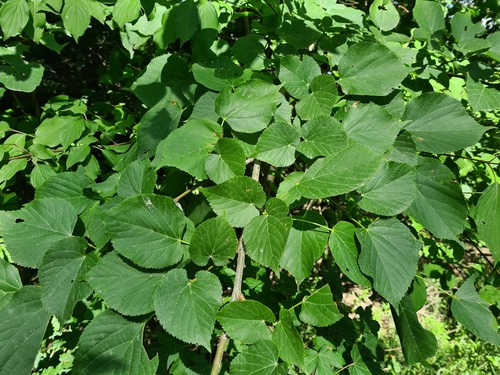
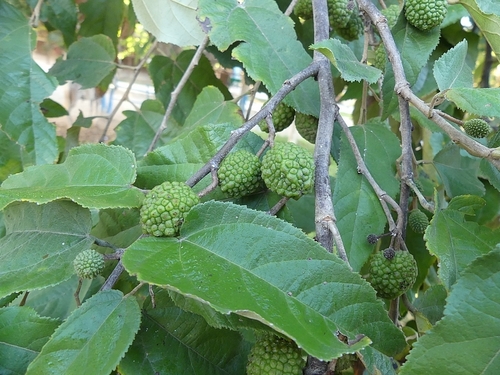
Guazuma ulmifolia Lam. is a tree that reaches up to 30 m in height and 30–40 cm in trunk diameter, with a rounded crown. Its leaves are arranged alternately in two flat rows, and range from ovate to lance-shaped. They have finely serrated margins, a typically rough texture, and measure 6–13 cm long by 2.5–6 cm wide. Three to five main veins grow from the leaf base, which is rounded or notched, and unequal-sided. The upper leaf surface is dark green, while the underside is paler green. Leaves are nearly hairless and thin. Leaf stalks are slender, 6–12 mm long, and covered with small star-shaped hairs. Branching indeterminate flower clusters called panicles grow 2.5–5 cm long, and form in the leaf axils below leaves. Flowers are numerous, short-stalked, small, brown-yellow, five-parted, 1 cm long, and lightly fragrant. The calyx has 2–3 lobes, and is covered in brown, light grey, or greenish hairs. Flowers have 5 petals, yellowish stamens, 15 anthers per pistil, 5 combined stigmas, a light green hairy ovary, and a style. The fruit is a capsule that is round to elliptical, 15–25 mm long, and contains many 3 mm long, grey, egg-shaped seeds. Guazuma ulmifolia is generally distributed across the Caribbean, Mexico, Central America, and South American countries including Colombia, Ecuador, Peru, Bolivia, Paraguay, Argentina, and Brazil. It is native to Antigua and Barbuda, Argentina, the Bahamas, Barbados, Bolivia, Brazil, Colombia, Cuba, Dominica, the Dominican Republic, Ecuador, Grenada, Guadeloupe, Guatemala, Haiti, Honduras, Jamaica, Martinique, Mexico, Montserrat, the Netherlands, Nicaragua, Costa Rica, Panama, Paraguay, Peru, Puerto Rico, St Kitts and Nevis, St Lucia, St Vincent and the Grenadines, Trinidad and Tobago, and the U.S. Virgin Islands. In its native range, Guazuma ulmifolia is a very important source of livestock fodder during the late dry season in dry areas, and it is the preferred fodder tree in Jamaica. The trees also provide shade for pastures, and can be used as living posts surrounding pastures. Immature fruits and leaves are fed to horses and cattle; fruits are also fed to domestic pigs in Puerto Rico and the Dominican Republic. Leaves and fruits are commonly fed to cattle through the dry season. The crunchy, woody fruits and their seeds are edible raw or cooked, with a mild sweet flavor similar to honey or granola. Gum from this plant (called pixoy gum) was used as a fixative in Maya stucco paintings at sites including Ek'Balam in Yucatán, Mexico. A beverage made from crushed seeds soaked in water is used medicinally to treat diarrhea, dysentery, colds, coughs, contusions, and venereal disease, and it is also used as a diuretic and astringent.