About Griselinia lucida (J.R.Forst. & G.Forst.) G.Forst.
Mature Height
This tree species, Griselinia lucida, typically reaches 10 to 15 metres in height.
Branch Characteristics
Its short, rough branches can grow up to 15 decimetres in diameter.
Leaf Shape
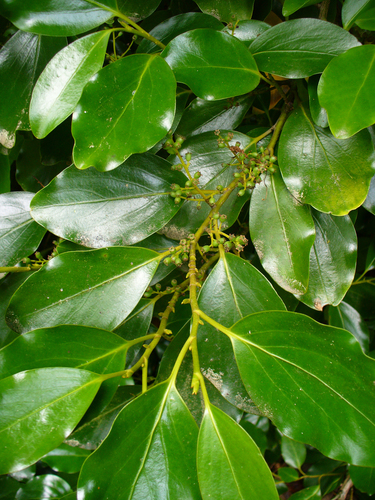
Apical leaves are smooth-margined, with shapes ranging from broad-ovate to ovate-oblong or rounded.
Leaf Size and Texture
These leaves are thick, glossy, and yellow-green, measuring 5–12 cm in length and 4–5 cm in width.
Leaf Base Trait
A characteristic trait is that one edge of the leaf base is usually slightly longer than the other.
Leaf Arrangement
Leaves are arranged alternately along stems.
Flower Inflorescence and Bloom Period
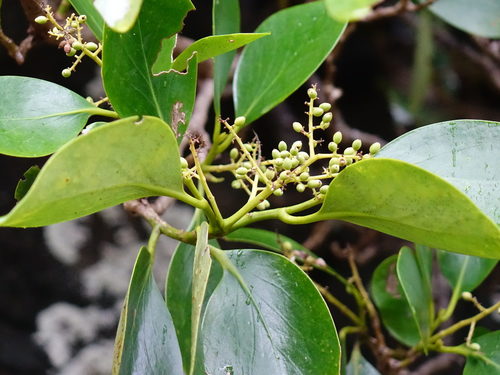
Small greenish flowers grow on slim twigs, produced from late spring to mid-summer, and form small panicles.
Pistillate Flower Structure
Pistillate flowers have five petals.
Flower Sexuality and Size
Flowers are unisexual, with male and female flowers growing on separate individual trees.
Sexual Dimorphism in Flowers
Female flowers lack petals, while male flowers have small greenish petals and measure around 5 mm in diameter; overall flowers are very small, 4–6 mm in diameter.
Pollination Method
Pollination occurs via wind and insects.
Berry Appearance
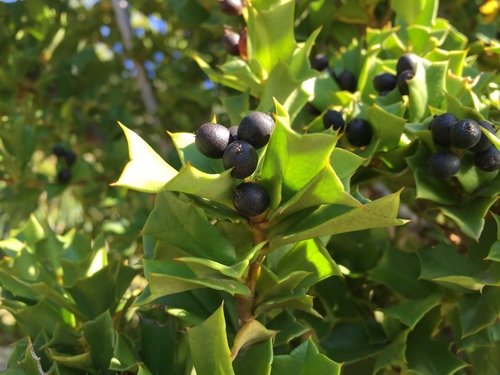
Dark purple or black berries are 6–7 mm long.
Berry Development Timeline
They first appear in mid-summer, staying green until near maturity, when they darken before falling to the ground.
Berry Ripening Period
Berries ripen from autumn to winter.
Geographical Distribution
This species is distributed throughout New Zealand’s North Island, and in the South Island it extends to North Canterbury in the east and South Westland.
Habitat and Elevation Range
It occurs from lowland up to high hill elevations, growing in both forest and shrubland habitats.
Distribution Pattern Across Islands
It is more common in the South Island than the North Island, and in the North Island it grows at higher average altitudes than in the South Island.
Epiphytic Growth Trait
It tolerates a range of environments, and can grow as an epiphyte in moist climates, with roots extending down to the ground to absorb water and nutrients.
Cultivation Use
It is commonly cultivated as wind-resistant screening or hedging to withstand exposed and extreme conditions.
Forest Growth Cycle Phases
Like other forest trees, it progresses through three phases of the forest growth cycle: gap phase, building phase, and mature phase.
Growth Cycle Phase Definitions
The gap phase occurs when a new canopy opening is available for colonisation, the building phase is when the growing seedling reaches canopy height, and the mature phase is when the established tree grows within an intact canopy.
Growth Rate by Cycle Phase
Griselinia lucida (often referred to as broadleaf in this growth data) grows faster during the building phase than in other phases.
Diameter Growth Rate
Diameter growth is faster during the gap and building phases at 0.31 cm per year, when leaves expand to capture sunlight for photosynthesis, compared to 0.19 cm per year during the mature phase.
Height Increment Rate
Average annual height increment for this species and other major local canopy species is 15 cm per year, with a recorded range of 10 to 18 cm per year.