About Griselinia littoralis (Raoul) Raoul
Overall Growth Form
Griselinia littoralis (Raoul) Raoul is a hardy evergreen shrub or tree that typically reaches around 10 metres tall, and can grow up to 15 metres. It has a rounded overall shape with dense foliage, rough short branches that can reach 150 cm in diameter.
Leaf Appearance
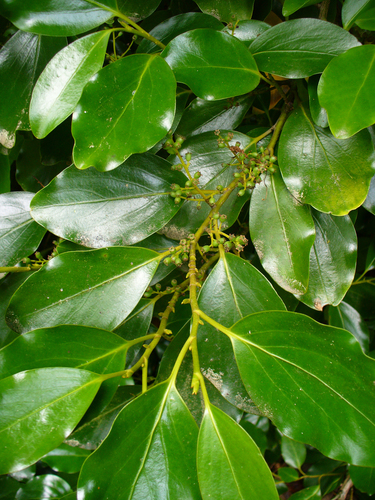
Its leaves are alternate, leathery and thick; they are glossy yellow-green on the upper surface, and paler and matte on the lower surface. Leaf shapes vary from oval, broad-ovate, ovate-oblong to rounded, all with smooth margins.
Leaf Size & Identifying Trait
Leaves measure 6–14 cm (2–6 in) long by 4–5 cm wide, and occasionally have an asymmetrical base, which is a typical characteristic of the species.
Flower Basics
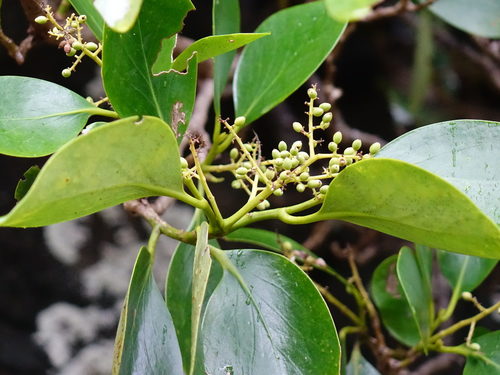
This species produces small greenish flowers that grow on thin twigs in small panicles from late spring to mid-summer. The species is dioecious: male and female flowers grow on separate individual plants.
Flower & Panicle Structure
Pistillate (female) flowers have five petals; staminate (male) flowers have five sepals and stamens and no petals. Each panicle is 2–5 cm (1–2 in) long and holds 50–100 individual flowers, each 3–4 mm across.
Pollination Method
Pollination is carried out by wind and insects, and requires male and female plants growing near each other for successful pollination.
Berry Development & Ripening
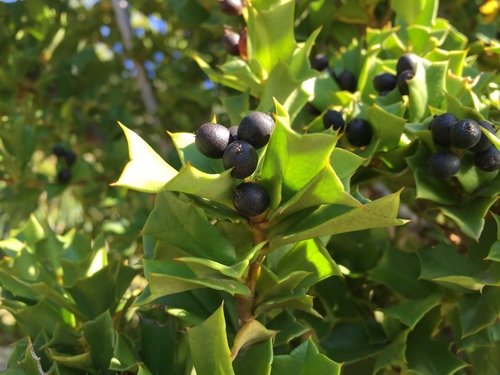
After flowering, 6–7 mm long dark purple or black berries form. Berries first appear in mid-summer and ripen from autumn to winter, staying green until they reach full maturity.
Seed Dispersal & Germination
Birds act as seed dispersers, spreading seeds away from parent plants to reduce competition for water, sunlight and nutrients, and allow the species to colonize new areas. Seeds germinate after falling to the ground.
Lifespan & Diameter Growth Rate
Griselinia littoralis has a long lifespan, generally over 50 years. Its growth rate follows the three stages of the forest growth cycle: diameter growth is faster during the gap and building phases, at 0.31 cm per year, when leaves expand to capture sunlight for photosynthesis, while diameter growth slows to 0.19 cm per year in the mature phase.
Height Growth & Epiphytic Habit
Height grows on average 15 cm per year, within a range of 10–18 cm per year. In moist climates, this species can grow as an epiphyte, with roots extending down to the ground to absorb water and nutrients.
Native Range
Griselinia littoralis is native to New Zealand, where it occurs throughout the country from the far north to Stewart Island, from sea level up to 900 m in altitude. It can be found in lowlands, high hills, forest, and shrubland.
Regional Distribution Pattern
It is more abundant in the South Island than the North Island, and grows at higher altitudes in the North Island than in the South Island. In its native range, it is very common in coastal areas.
Epithet Etymology
The Latin specific epithet littoralis means "growing by the sea".
Environmental Tolerances
This hardy species tolerates sea breeze, wind exposure, and salt carried by sea gales. It can survive a wide range of habitats and conditions, tolerates temperatures from approximately −10 °C (14 °F) up to 35 °C (95 °F), and grows well in full sun or partial shade.
Preferred Soil & Climate
Like most New Zealand native plants, it can survive on very low nutrient levels, but grows better in higher nutrient conditions, and favours high rainfall areas. It prefers free-draining, light loamy soil.
Cultivation & Uses
It is widely cultivated in New Zealand and in other regions with mild oceanic climates, including the south coast of Great Britain and the Faroe Islands. It is often planted as a wind-resistant screen, and valued for its tolerance of salt from sea gales.