About Grevillea wilsonii A.Cunn.
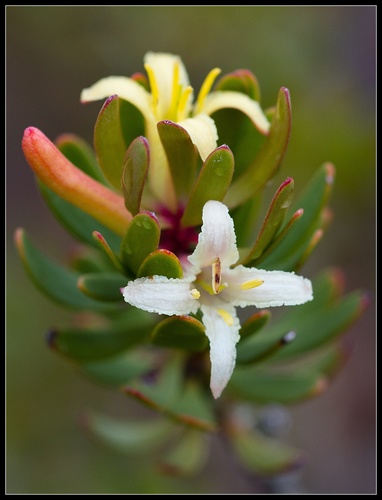
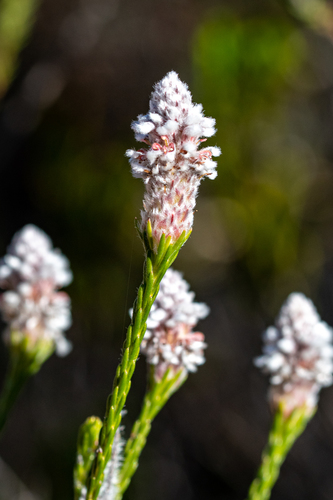
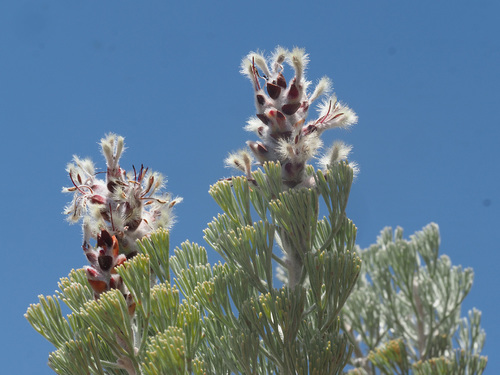
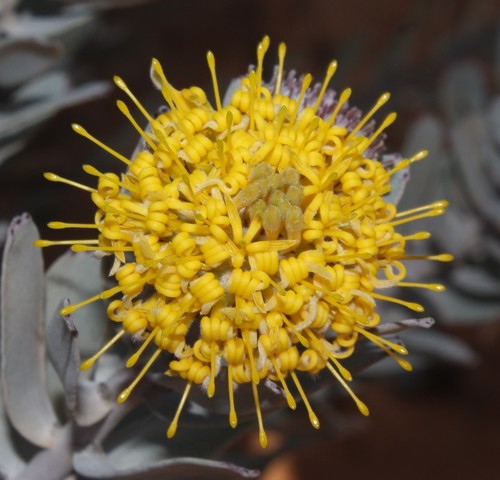
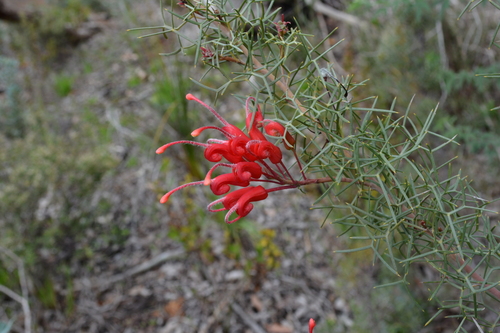
Grevillea wilsonii A.Cunn., also known as Wilson's grevillea, is an erect, compact to spreading shrub that typically grows 0.4 to 1 metre (1 ft 4 in to 3 ft 3 in) tall and forms a lignotuber. In outline, its leaves are mostly 20–60 mm (0.79–2.36 in) long and 4–6 mm (0.16–0.24 in) wide, and are deeply lobed. Leaves have 6 to 13 widely spreading lobes, which are further divided, with linear end lobes that measure 5–30 mm (0.20–1.18 in) long and 0.7–1.1 mm (0.028–0.043 in) wide. The lobe edges are rolled under, enclosing the lower leaf surface except for the mid-vein, and the grooves on either side of the mid-vein are hairy. Flowers are erect and arranged in sometimes branched clusters, each roughly spherical on a rachis 4–16 mm (0.16–0.63 in) long, with flowers closer to the rachis base opening first. Flowers are green when in bud, turn red after opening, and become black as they age. The pistil of the flower is 30.0–35.5 mm (1.18–1.40 in) long. Flowering occurs mainly from July to December, and the fruit is a roughly spherical to oblong follicle 12.5–18 mm (0.49–0.71 in) long. This grevillea grows in jarrah forest or woodland between Bindoon, Harvey, Northam and Williams, in the Avon Wheatbelt, Jarrah Forest, and Swan Coastal Plain bioregions of south-western Western Australia. In horticulture, this species requires well-drained soil and grows in full sun or partial shade. It can be propagated from cuttings, and grafting on Australia's east coast often produces more reliable results.