About Leucospermum rodolentum (Knight) Rourke
Overall Growth Habit
Leucospermum rodolentum is an upright, spreading shrub that reaches up to 3 m (10 ft) high and 4 m (13½ ft) in diameter. It grows from a single trunk at its base, 8–14 cm (3¼–4¾ in) thick, covered in smooth, grey bark.
Flowering Stem Characteristics
Upright flowering stems are 5–7 mm in diameter and appear grey, from a dense layer of fine, grey, crisped hairs.
Leaf Shape and Size
Its leaves are elliptic to wedge-shaped, 4–6½ cm (1.8–2.6 in) long and ¾–1½ cm (0.3–0.6 in) wide, with a blunt or tapering base and a rounded or truncated tip that has 3 to 6 teeth. The leaf surface is grey from a dense layer of fine, short, crisped hairs.
Flower Head Shape and Arrangement
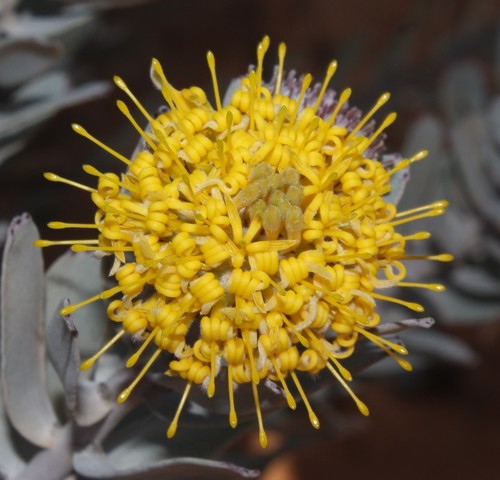
The flower heads are globe-shaped, 3–3½ cm (1.2–1.4 in) across, and are either seated or have a short stalk up to ½ cm (0.2 in) long. Flower heads typically grow in groups of two, three, or four, and rarely occur individually.
Flower Head Common Base
The common base shared by all flowers in one head is flattened cone-shaped, about 1 cm (0.4 in) long and ¾ cm (0.3 in) across.
Involucral Bract Characteristics
The greyish bracts that subtend the entire flower head are oval with a pointed tip, 5−7 mm (0.20–0.28 in) long and 2–3 mm (0.08–0.12 in) wide. They are tightly overlapping and have a cartilaginous texture.
Individual Flower Bract
The carmine bract that subtends each individual flower is narrowly lance-shaped with a pointed tip, about 2 cm (0.8 in) long and 2 mm (0.08 in) wide. This bract wraps around the base of the perianth, is thickly woolly at its base, covered in powdery hairs near the tip, and fringed with equally long hairs.
Perianth Overall Structure
The straight, deep yellow perianth is 4-merous, straight and cylinder-shaped when in bud, and 1½–2½ cm (0.6–1.0 in) long. The lowest, fully fused section of the perianth, called the tube, is cylinder-shaped, about 5 mm long, hairless, and hyaline.
Perianth Claws
The middle section, or claws, where the perianth splits lengthwise, curls backward in its upper half. The claw facing the edge of the flower head is thinly covered in silky hairs, while the other three claws lose any hairs they had in bud very quickly.
Perianth Limbs
The upper section, or limbs, which enclose the pollen presenter when in bud, consists of four lance-shaped segments with pointed tips. These segments are still tinged green in bud, about 3 mm (0.12 in) long and 1 mm (0.04 in) wide, and bear very few silky hairs.
Style and Pollen Presenter
A straight style 1½–2½ cm (0.6–1.0 in) long emerges from the perianth; it tapers near the tip and sometimes curves slightly away from the center of the flower head. The thickened tip of the style, called the pollen presenter, is hoof-shaped to bluntly cylinder-shaped, about 2 mm (0.08 in) long, with a groove that acts as the stigma across its very tip.
Ovary Scales
The ovary is subtended by four opaque, awl-shaped scales about 1 mm long.
General Distribution Range
This species, commonly called the sandveld pincushion, occurs naturally from Darling in the south, through the Hopefield, Piketberg, and Clanwilliam districts, to Heerenlogementberg and Nardouw Pass. An isolated population is found south of the Brandvlei Dam.
Extinct Populations
Isolated populations near Kraaifontein recorded in the 1960s and at Salt River in the 19th century, which is now a Cape Town suburb, have gone extinct due to urban expansion.
Habitat and Altitude
The sandveld pincushion is a prominent component of sandveld vegetation, growing on sandy flats in the west of South Africa's Western Cape province, between sea level and 250 m (800 ft), and rarely up to 300 m (1000 ft) altitude. It often grows alongside Leucadendron pubescens and several large, tufted Restionaceae such as Willdenowia.
Substrate Preference
It only grows in loose, very often stabilised Tertiary or Quaternary drift sands. The average annual precipitation in its native range is 380–500 mm (15–20 in), falling mostly during the winter half of the year.
Pollinators
This species is pollinated by insects, including honey bees, monkey beetles, and skippers, and is also visited by birds such as the Cape sugarbird, orange-breasted sunbird, and Cape weaver.
Seed Dispersal and Germination
Ripe fruits fall to the ground around two months after flowering, where native ants collect the fruits and carry them back to their nests. The seeds remain underground there, protected from fires and seed-eating rodents and birds, until an overhead fire clears the vegetation and triggers the seeds to germinate.