About Grevillea victoriae F.Muell.
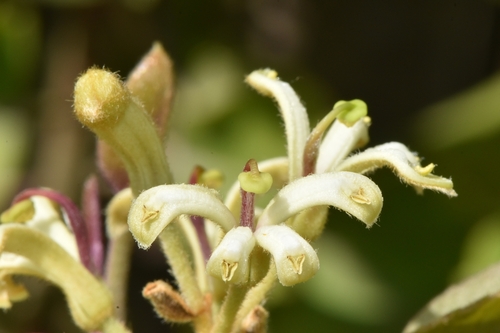
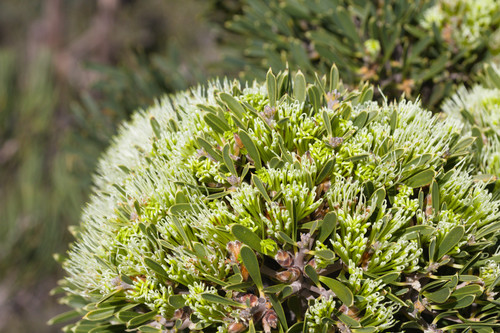
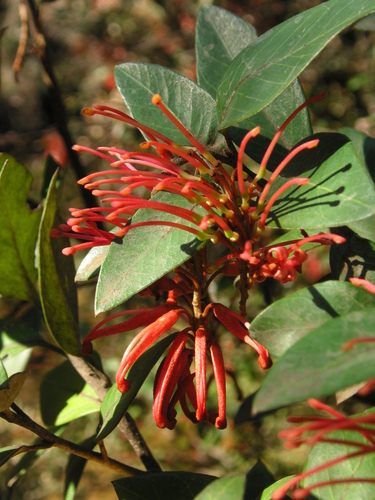
Grevillea victoriae F.Muell. is an erect to spreading shrub that grows between 0.2 and 4 metres (7.9 inches to 13 feet 1.5 inches) in height, and has branchlets that are more or less covered in silky hairs. Its leaves are elliptic, narrowly elliptic to lance-shaped, and sometimes egg-shaped, measuring 60 to 120 millimetres (2.4 to 4.7 inches) long and 10 to 35 millimetres (0.39 to 1.38 inches) wide. The upper surface of the leaves is more or less glabrous, while the lower surface is densely covered in silky or woolly hairs. The flowers range in colour from red to orange, and are arranged at the ends of branches or in leaf axils, forming pendant, conical to loose, sometimes branched clusters on a rachis 20 to 90 millimetres (0.79 to 3.54 inches) long. The pistil is 17 to 26 millimetres (0.67 to 1.02 inches) long. Flowering can occur in any month of the year, but takes place mainly from August to January when there is no snow. The fruit is a glabrous follicle 17 to 20 millimetres (0.67 to 0.79 inches) long. This species grows in rocky, mountainous areas of south-eastern Australia, where it inhabits forest, woodland and heath. Associated tree species include Eucalyptus pauciflora and Eucalyptus delegatensis. G. victoriae subsp. victoriae grows on some of Victoria's highest mountains, including Mount Bogong, Mount Buffalo, Mount Buller, Mount Hotham, Mount Howitt, Mount St Bernard and Mount Torbreck. G. victoriae subsp. nivalis grows in sub-alpine areas around Mount Kosciuszko and nearby ranges, from Mount Gibbo and Mount Sassafras in the Victorian Alps northwards to Talbingo in New South Wales. It may rarely be found growing above the treeline. G. victoriae subsp. brindabella grows in the Brindabella Range, on the border between New South Wales and the Australian Capital Territory. Eastern spinebills and yellow-faced honeyeaters are known to feed on the nectar of Grevillea victoriae sensu lato. In Kosciuszko National Park, it has been observed that many bird species leave the area after Grevillea victoriae finishes flowering in January. Taxa within the Grevillea victoriae complex are believed to be fire intolerant, and only regenerate from seed. Grevillea victoriae has a reputation as a hardy and reliable plant in cultivation, and has been grown successfully in all states of Australia, as well as New Zealand, the United States and Great Britain. Cultivated plants require a well-drained position with full sun exposure or partial shade, and benefit from pruning to maintain a more compact shape. As it originates from mountainous regions, the species has a high tolerance to frost and snow. It is useful as a screening plant and to attract birds to gardens. In certain parts of North America, hummingbirds feed on the flowers of cultivated plants during the winter. Plants are easily propagated by seed or cuttings, and have been successfully grafted onto Grevillea robusta rootstocks.