About Grevillea vestita (Endl.) Meisn.
Growth Form and Height
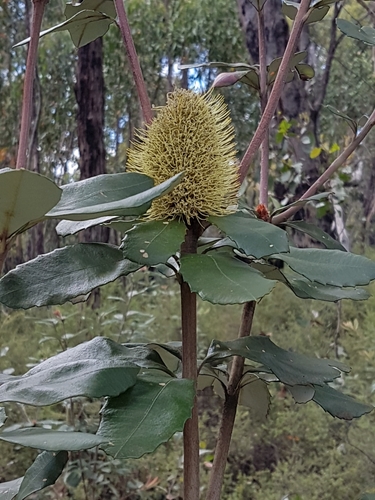
Grevillea vestita is an erect, spreading, prickly shrub that typically grows to a height of 0.6–4.5 m (2 ft 0 in – 14 ft 9 in), and has branchlets covered in woolly to shaggy hairs.
General Leaf Dimensions
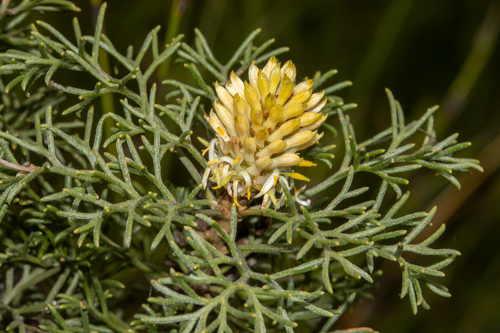
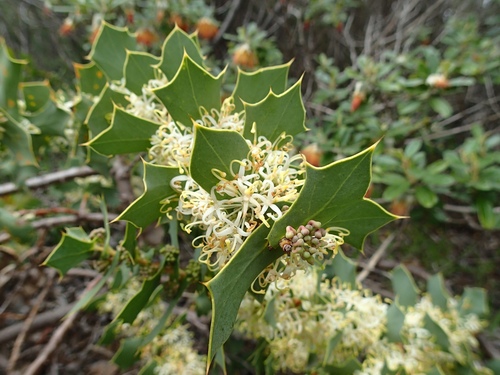
In outline, its leaves are mostly 10–40 mm (0.39–1.57 in) long and 6–35 mm (0.24–1.38 in) wide, and are lobed.
Subspecies isopogoides Leaf Lobes
Subspecies isopogoides usually has 3 to 5 lobes, which are often further divided, with narrowly triangular, sharply-pointed end lobes.
Subspecies vestita Leaf Lobes
Subspecies vestita usually has 3 lobes or teeth, sometimes further divided, with end lobes that are egg-shaped to triangular.
Leaf Margin Characteristics
The edges of the lobes curve downward or roll under, sometimes completely enclosing the hairy lower leaf surface.
Inflorescence Arrangement
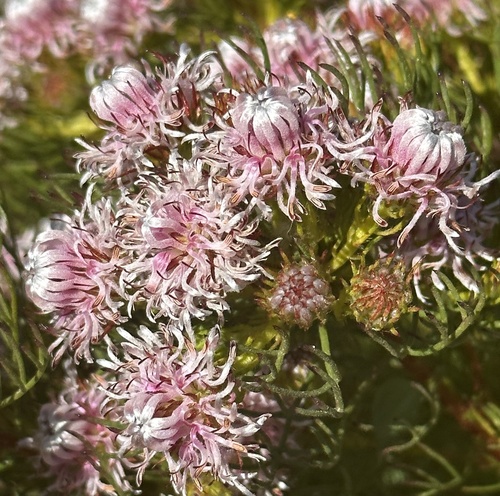
Its flowers are arranged in spherical to dome-shaped clusters, with flowers closer to the base of the rachis blooming first.
Flower Color and Texture
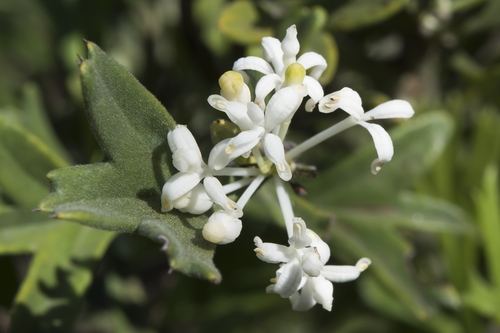
The flowers are hairless, and range from white to cream-coloured, often with a pink tint.
Pistil Length
The pistil is 4.0–6.1 mm (0.16–0.24 in) long.
Flowering Period and Fruit
Flowering occurs mainly from June to September or October, and the fruit is a smooth, oblong follicle 8–10.5 mm (0.31–0.41 in) long.
Subspecies isopogoides Distribution and Habitat
Subspecies isopogoides grows in heath and scrub, mainly between Kalbarri, Three Springs, Mullewa and Mingenew, within the Avon Wheatbelt, Geraldton Sandplains and Yalgoo bioregions of Western Australia.
Subspecies vestita Distribution and Habitat
Subspecies vestita grows in heath or woodland between Badgingarra, Pingelly and Williams, and in near-coastal areas between Yanchep and Cape Naturaliste, in the Avon Wheatbelt, Geraldton Sandplains, Jarrah Forest and Swan Coastal Plain bioregions of south-western Western Australia.
Horticultural Traits
In horticulture, this species is noted for being free-flowering and adapts well to cultivation.
Cultivation Tolerance and Pruning
It can tolerate moderate frost and moderate humidity, and responds well to pruning.
Propagation Methods
It can be grown from seed, but is most often propagated from cuttings.