About Grevillea trifida (R.Br.) Meisn.
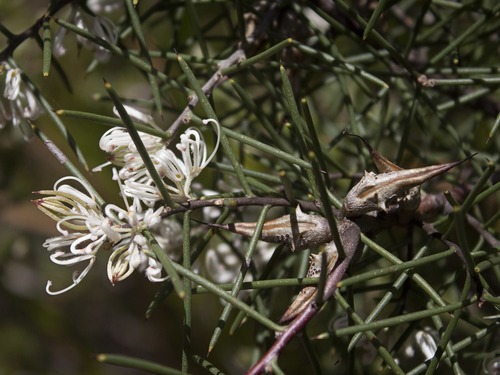
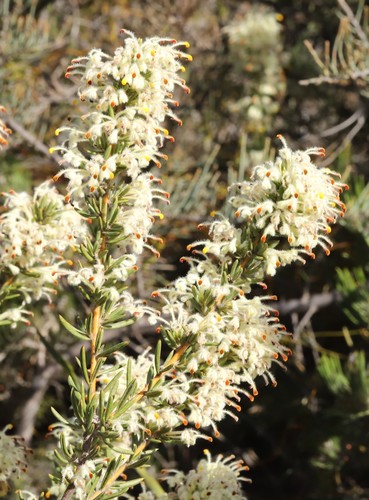
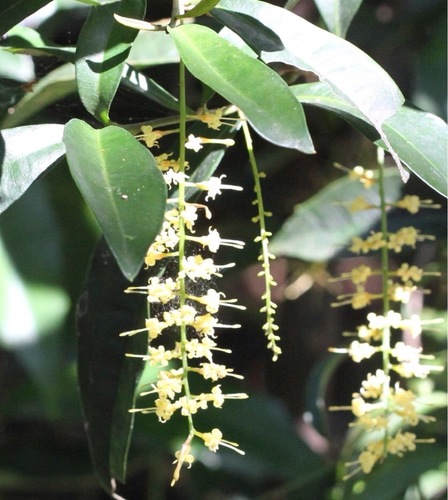
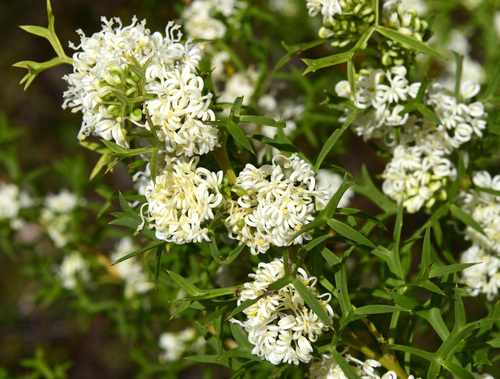
Grevillea trifida is a spiny, erect to low-growing spreading shrub that usually reaches a height of 0.3 to 1.7 metres (1 foot 0 inch to 5 feet 7 inches), and its branchlets have a silky hair covering. Its leaves are most often divided, between 20 and 70 millimetres (0.79 to 2.76 inches) long. Some leaves are linear to elliptic, with 5 to 9 triangular teeth along their edges. Others are wedge-shaped with 3 to 5 lobes, where the end lobes are triangular to linear, 2 to 20 millimetres (0.079 to 0.787 inches) long and 1 to 4 millimetres (0.039 to 0.157 inches) wide. All leaf lobes end in sharp points, and leaf edges curve downward or roll under, without hiding the lower surface of the leaf. Flowers grow in clusters in leaf axils or at the ends of branches; the clusters are sometimes branched, umbel-shaped, and form on a woolly hairy rachis that is 0.2 to 0.5 millimetres (0.0079 to 0.0197 inches) long, with flowers closer to the rachis tip opening first. Flowers are white to cream-coloured, and the pistil measures between 5.0 and 7.5 millimetres (0.20 to 0.30 inches) long. Flowering occurs mainly from July to November. After flowering, the fruit is an oval to elliptic follicle 7.5 to 9.5 millimetres (0.30 to 0.37 inches) long. This species grows in sandy or gravelly soils in jarrah forest, shrubland and swampy locations. It is widespread across south-western Western Australia, ranging from Cape Naturaliste to near the Stirling Range, and occurs in the Avon Wheatbelt, Esperance Plains, Jarrah Forest, Mallee, Swan Coastal Plain and Warren bioregions.