About Grevillea speciosa (Knight) Mc Gill.
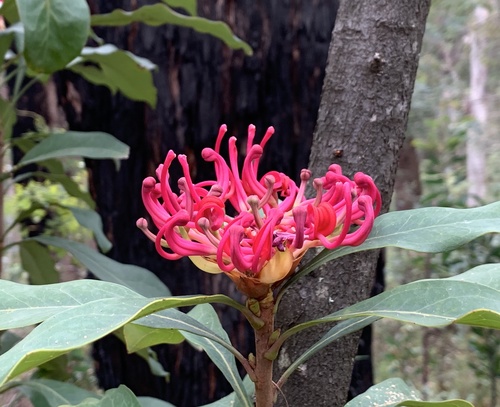
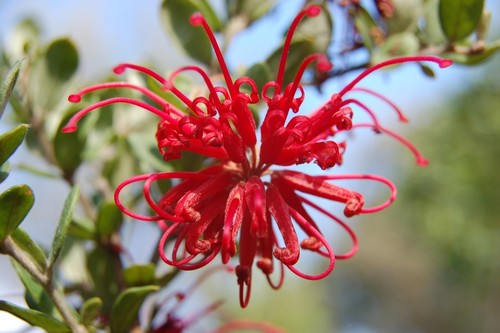
Grevillea speciosa (Knight) Mc Gill. is an erect shrub that typically grows 0.4 to 3 metres (1 foot 4 inches to 9 feet 10 inches) tall, with branchlets covered in silky to shaggy hairs. Its leaves are elliptic to egg-shaped with the narrower end at the base, or nearly circular, usually 10 to 40 millimetres (0.39 to 1.57 inches) long and 4 to 12 millimetres (0.16 to 0.47 inches) wide, with downward-turned edges. The lower surface of the leaves is covered in silky to soft hairs. Its flowers grow in large, downturned, dome-shaped to spherical clusters 20 to 40 millimetres (0.79 to 1.57 inches) long; the flowers are most often red, rarely pink, and very rarely cream-coloured. The pistil is 25 to 35 millimetres (0.98 to 1.38 inches) long, and the style curves gently. Flowering occurs mainly from July to October, and the fruit is an elliptic to narrowly oval follicle 12 to 20 millimetres (0.47 to 0.79 inches) long. It can be distinguished from the similar species Grevillea oleoides primarily by its shorter, more ovate leaves. This species, commonly known as red spider flower, grows on ridgetops and hillsides in moist heath, low woodland and forest in sandy soil. Its natural range is along the central coast of New South Wales, from Gosford, Kulnura and Bucketty to just south of Port Jackson. G. speciosa is sold at many nurseries and is cultivated for its bright, usually red flowers. Pink-flowered cultivated forms exist, and may come from hybridisation with other grevillea species. It tolerates a wide range of climates, and can be grown in both coastal and inland environments. It grows best in a full-sun or part-shade position, in either acidic or neutral, well-drained sandy loam or clay soil that is not excessively dry.