About Grevillea sericea (Sm.) R.Br.
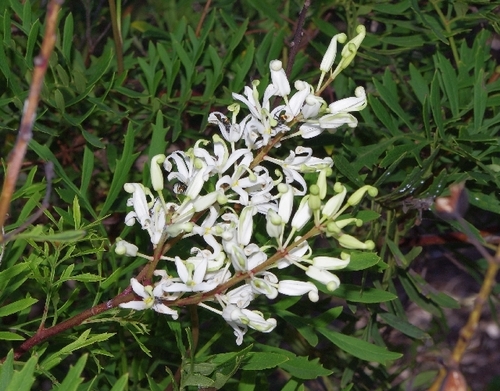
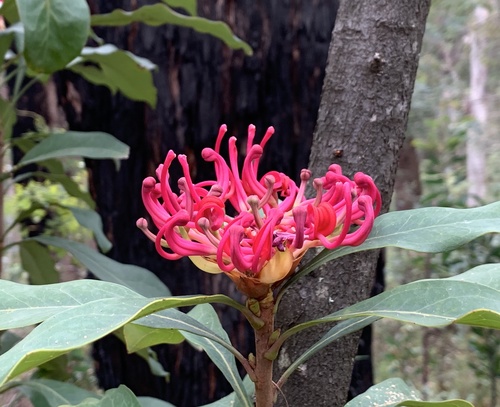
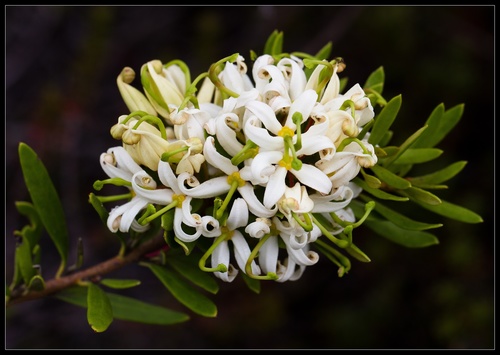
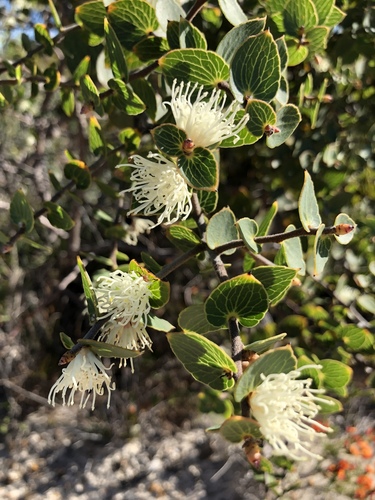
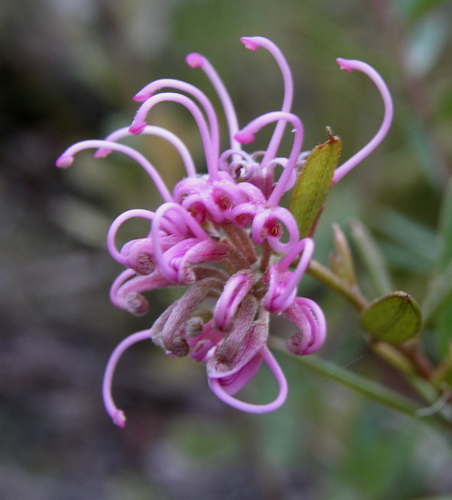
Grevillea sericea (Sm.) R.Br. is a shrub that typically reaches a height of 0.5 to 2 meters (1 foot 8 inches to 6 feet 7 inches). It has angular, ridged branchlets covered in silky hairs. Its leaves are 25 to 120 millimeters (0.98 to 4.72 inches) long and 2 to 9 millimeters (0.079 to 0.354 inches) wide, with size and shape that varies between subspecies. The flowers are most often pink or deep purplish pink, and rarely white or reddish. They grow in clusters arranged more or less along one side of a 15 to 60 millimeter (0.59 to 2.36 inch) long rachis, and the pistil is 14 to 19 millimeters (0.55 to 0.75 inch) long. Flowering occurs mainly from August to December, and the fruit is a hairless, narrowly oval to elliptic follicle 9 to 16 millimeters (0.35 to 0.63 inch) long. This species is commonly called pink spider flower, and it is widespread in New South Wales, where it grows in woodland and open forest. Its range extends from near Toronto and Wyee south to near Heathcote, and inland to near Mudgee. Subspecies riparia has a more limited distribution, growing near permanent streams, mainly near the Blue Mountains escarpment along the Grose and Colo Rivers and Glenbrook Creek. This species is commonly cultivated as an ornamental shrub, valued for its compact, bushy growth habit and profusion of flowers in various shades of pink and white. Its flowers attract both native bees and European honey bees. It grows best in full sun to partial shade, in well-drained, slightly acidic sandy loam soils in a warm temperate climate. It tolerates drought and mild frost, and can be propagated by cuttings or grown from seed. The cultivar 'Collaroy Plateau' is a hybrid between G. sericea ssp. sericea and G. speciosa.