About Grevillea rosmarinifolia A.Cunn.
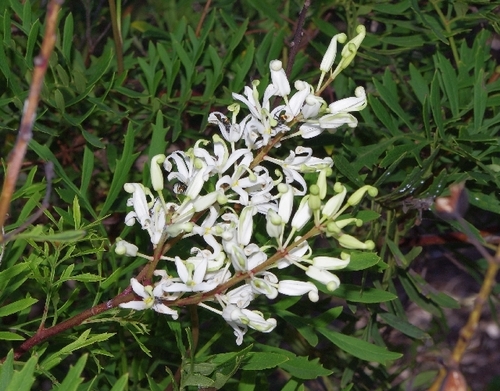
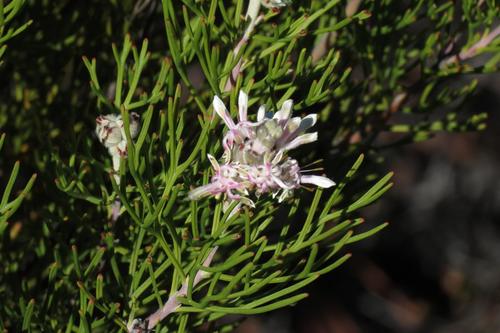
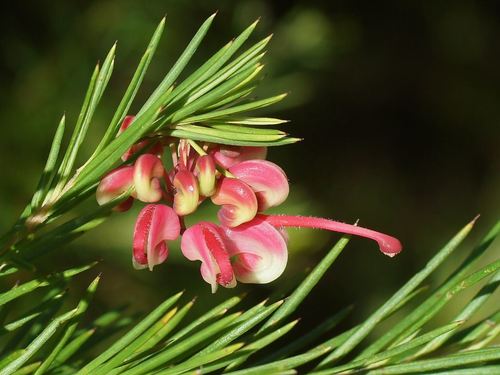
Grevillea rosmarinifolia A.Cunn. is usually an erect, compact to open, and sometimes low-growing shrub. It typically reaches a height of 0.3–2 m (1 ft 0 in – 6 ft 7 in). Its leaves are linear to narrowly elliptic or narrowly oblong, measuring 8–38 mm (0.31–1.50 in) long and 0.7–3 mm (0.028–0.118 in) wide, with rolled under edges that usually conceal the lower leaf surface. Flowers are arranged at the ends of branches, usually in groups of 4 to 12, on a hairless rachis 2–8 mm (0.079–0.315 in) long. The flowers are pink to red, with a pistil 15–22.5 mm (0.59–0.89 in) long. Flowering occurs from August to December, and the fruit is a hairy, oblong follicle 8–11 mm (0.31–0.43 in) long. Commonly called rosemary grevillea, this species is native to New South Wales and Victoria, Australia, and is naturalised in South Australia and the Australian Capital Territory. Subspecies glabella grows in mallee or shrubland on sandy soils, found in the Rankins Springs to Griffith area of southern New South Wales and the Little Desert area of western Victoria. Subspecies rosmarinifolia grows in open forest or woodland in montane areas of south-eastern New South Wales, and in isolated inland areas of Victoria between Gippsland, Melbourne, Skipton and the Brisbane Ranges. This grevillea is common in cultivation, and all forms are easily grown from cuttings. The type form originating from the Coxs River was thought to be extinct in the wild, but was rediscovered by Donald McGillivray growing outside the Royal Botanic Garden Edinburgh in 1969. Grevillea rosmarinifolia prefers full sun, is drought tolerant, and can survive temperatures as low as −10 °C (14 °F). In the United Kingdom, it has received the Royal Horticultural Society's Award of Garden Merit.