About Grevillea petrophiloides Meisn.
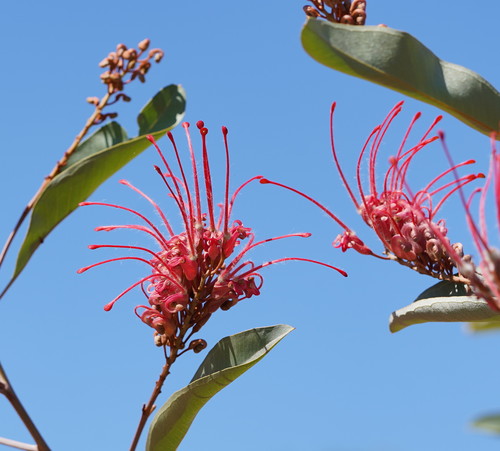
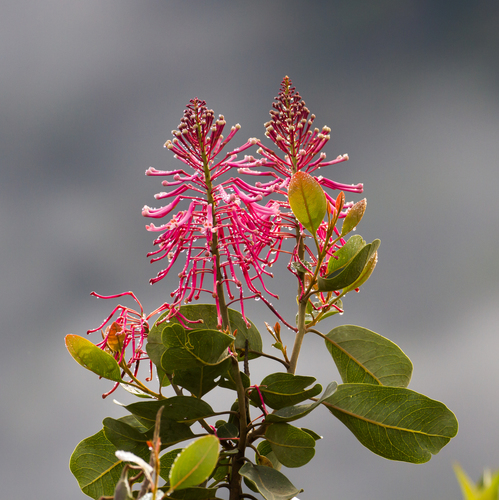
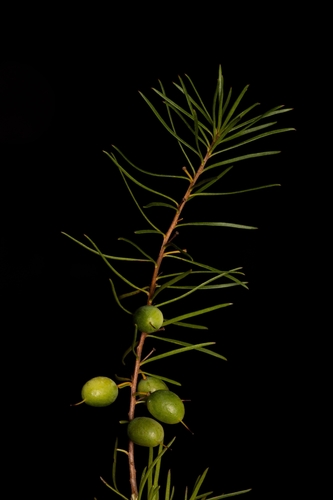
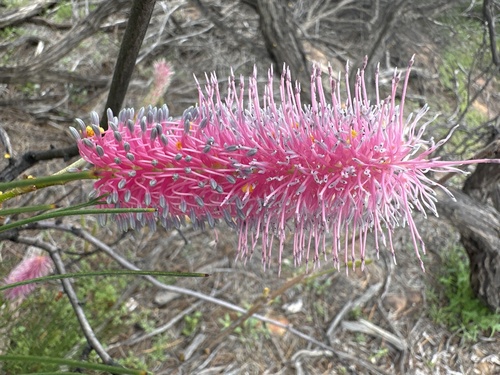
Grevillea petrophiloides is an erect shrub that usually reaches a height of 1 to 4 meters (3 feet 3 inches to 13 feet 1 inch). Its leaves are 60 to 250 millimeters (2.4 to 9.8 inches) long and divided, with 3 to 9 lobes that are sometimes further divided to produce more than ten linear end lobes. These end lobes measure 10 to 130 millimeters (0.39 to 5.12 inches) long and 0.5 to 3.5 millimeters (0.020 to 0.138 inches) wide. Flowers of this species are arranged in clusters at the ends of sometimes branched canes that sit above the foliage, with cylindrical clusters growing on a rachis 60 to 200 millimeters (2.4 to 7.9 inches) long. Flower color is most often pink to reddish pink and bluish-grey, with color variation between subspecies, and the pistil is between 14 and 21.5 millimeters (0.55 to 0.85 inches) long. Flowering time also differs between subspecies, and the fruit produced is an oval to roughly spherical follicle 7 to 18 millimeters (0.28 to 0.71 inches) long. Three subspecies are known to occur in south-western Western Australia, each with different habitat and distribution. Subspecies magnifica grows on or near granite outcrops, mostly between Tammin and Pantapin in the Avon Wheatbelt and Mallee bioregions. Subspecies petrophiloides grows in shrubland or heath on sandplains, found between the lower Murchison River, Quairading and Hyden in the Avon Wheatbelt, Geraldton Sandplains and Mallee bioregions. Subspecies remota grows on or near granite outcrops, ranging from near Varley to Norseman in the Avon Wheatbelt, Coolgardie and Mallee bioregions.