About Grevillea hilliana F.Muell.
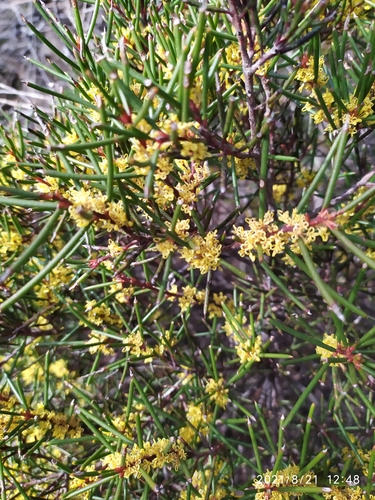
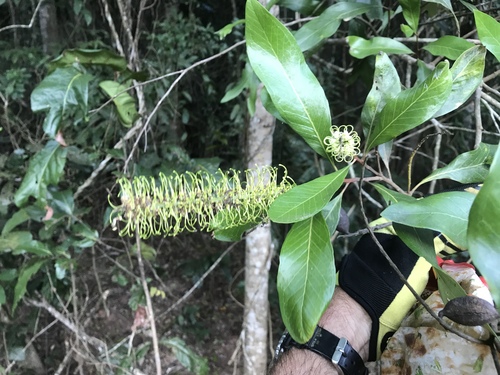
Grevillea hilliana F.Muell. is a tree that usually reaches a height of 8 to 30 metres (30 to 100 feet). Young plants of this species typically have divided leaves, which are mostly 250 to 400 millimetres (10 to 16 inches) long and 150 to 300 millimetres (6 to 12 inches) wide, with three to ten linear to lance-shaped lobes. These lobes are 80 to 250 millimetres (3 to 10 inches) long and 10 to 50 millimetres (0.4 to 2.0 inches) wide, and have a silky-hairy lower surface. Adult leaves are either lance-shaped to oblong, measuring 90 to 240 millimetres (4 to 9 inches) long and 15 to 60 millimetres (0.6 to 2.4 inches) wide, or sometimes divided with four to six oblong to egg-shaped lobes. These lobes are 60 to 120 millimetres (2.4 to 4.7 inches) long and 20 to 40 millimetres (0.8 to 1.6 inches) wide, and also have a silky-hairy lower surface. The flowers are arranged in large, cylindrical clusters 80 to 220 millimetres (3 to 9 inches) long, and are coloured white to pale green. The pistil is 13.5 to 16 millimetres (0.53 to 0.63 inches) long and glabrous. Flowering occurs mainly from July to October, and often happens in other months as well. The fruit is a glabrous, oval to elliptic follicle 17 to 26 millimetres (0.7 to 1.0 inch) long. This species, also known as white silky oak, grows in or near the edges of rainforest in near-coastal areas, from sea level up to an altitude of 600 metres (2,000 feet). Its range extends from near Cooktown in far northern Queensland to near the Brunswick River in north-eastern New South Wales. In New South Wales, it is only found in small, fragmented populations near Brunswick Heads and in remnant habitat patches in the Tweed Shire.