About Grevillea baileyana Mc Gill.
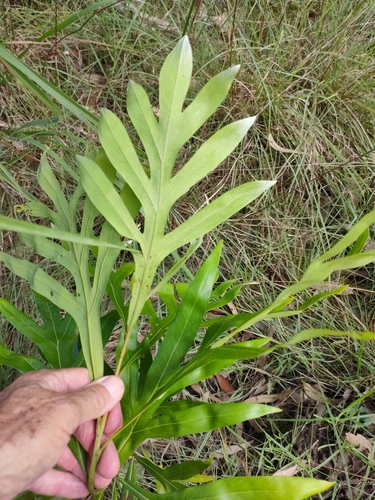
In its native rainforest habitat, Grevillea baileyana (previously referenced as Grevillea edelfeltii here) can grow as a tree reaching 30 m (100 ft) in height. It has hard, scaly grey bark. Both adult and juvenile leaves are between 6 and 30 cm (2.4–11.8 in) long. Juvenile leaves are pinnatifid, meaning they are divided into five to nine lanceolate, spear-shaped lobes on each side of the leaf. Adult leaves are simple, spear-shaped (lanceolate), and measure 1–6 cm wide, rarely reaching 10 cm (0.4–4 in) wide. The upper leaf surface is shiny, smooth green with a prominent midvein, while the lower leaf surface is covered in rust-coloured fur. Flowerheads emerge in spring and summer, from August to December; they are greenish when in bud and turn white when fully mature. This species is found in New Guinea and Australia. In Australia, it occurs in northeastern Queensland, specifically in the McIlwraith Range near Coen, and extends from Cooktown south to Ingham. It grows in rainforests and on rainforest margins, most commonly on granite-based soils. Its fragrant white flowerheads and green foliage make it an attractive garden plant. It grows best in compost-rich, acidic soil with good drainage. It is long-lived in cultivation and typically only reaches 8 to 10 metres (25–35 ft) tall when grown in gardens. While it flowers prolifically in tropical regions, plants grown in temperate areas may take many years to produce their first flowers. It is generally propagated by seed, though propagation from cuttings has also been successful. Its white or pinkish grained wood is suitable for wood turning and cabinet making. Its foliage is popular for floral arrangements, valued for the unique contrast between its dark green upper surface and gold to bronze underside. The species was one of 5 selected to trial as a 'native foliage product', chosen from an original pool of 21 candidates based on evaluations of vase life, adaptability to different climates, and market acceptance. Foliage of this species was used in the bouquets given to medal winners at the 2000 Summer Olympics in Sydney.