About Mimetes splendidus Knight
Overall Growth Form
Mimetes splendidus is an evergreen, sparsely branching, upright shrub that grows up to 2.5 m (8 ft) high. It develops from a single trunk up to 6 cm (2.5 in) thick, covered in thin grey bark that is smooth apart from horizontal striping.
Stem Characteristics
In older plants, lower stems lose their leaves. Young branches are stiffly upright, rarely branching, 6–10 mm (0.24–0.40 in) thick, covered in silky hairs, and later tilt over.
Leaf Structure
Leaves grow alternately along the branches, angled upward and overlapping; they have no stipules or leaf stalks, are broadly lance-shaped or elliptic, 4–5.5 cm (1.6–2.2 in) long and 1.8–2.5 cm (0.7–1 in) wide. Their dense covering of silky hairs gives the leaves a silvery color; leaves end in more or less pointed tips, often with three or four closely cropped thickened teeth that are reddish or amber-colored.
Inflorescence Shape
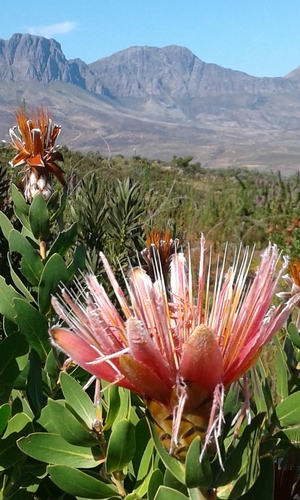
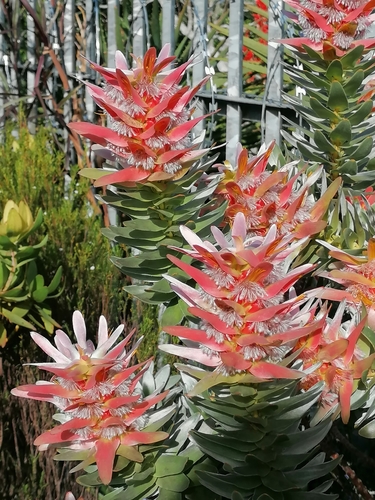
The inflorescence is broadly cylinder-shaped, 8–12 cm (3.3–4.8 in) long and 6–8 cm (2.3–3.1 in) in diameter, and topped by relatively small, more or less flattened, silvery-pink leaves. In the axils of the leaves just below this top crest, flower heads grow that each hold 10 to 14 flowers.
Subtending Leaf Features
The subtending leaves have ears at their base, forming a hood over the flower head beneath that flushes brilliant orangey pink during flowering. The bracts that encircle each flower head are broadly oval to inverted egg-shaped or somewhat rectangular, with a blunt tip.
Outer Bract Traits
Their surface is hairless or covered in fine powdery hairs, with a fringe of hairs along the margin; they are papery when dry, warm yellow or amber-colored when fresh, with margins curving inward to envelop the base of the flowers, measuring 1.3–1.8 cm (0.5–0.7 in) long and 0.7–1 cm (0.28–0.39 in) wide. The inner whorl of bracts is lance-shaped to narrowly lance-shaped, with a sharp pointed tip, 1.5–4 cm (0.6–1.6 in) long and 0.75–1 cm (0.3–0.4 in) wide.
Individual Flower Bracts
The bract subtending each individual flower is line-shaped, 12–16 mm (0.47–0.63 in) long, about 2 mm (0.08 in) wide, and covered in dense silky hairs.
Perianth Structure
The 4-parted perianth is 3–3.5 cm (1.2–1.4 in) long. The lower part, which remains merged when the flower opens, is slightly inflated, hairless, and about 3–4 mm (0.12–0.16 in) long.
Perianth Segments
The middle segments (or claws) are thread-shaped and covered in silky hairs. The upper segments (or limbs), which enclose the pollen presenter in the bud, are boat-shaped, line-shaped with a pointed tip in outline, 8–10 mm (0.31–0.39 in) long, covered in dense silky hairs, with a tuft of stiff hairs at the tip.
Style and Pollen Presenter
A straight, thread-shaped style 4.5–5.5 cm (1.8–2.2 in) long emerges from the center of the perianth. The thickened tip of the style, called the pollen presenter, is 5–7 mm (0.2–0.28 in) long, line-shaped with a pointed tip and a thickened ring at its base.
Ovary and Scales
The stigmatic groove sits obliquely across the very tip of the pollen presenter. The egg-shaped ovary is covered in silky hairs and about 1 mm (0.04 in) long. It is subtended by four bright orange, fleshy, awl- to line-shaped scales about 2 mm (0.08 in) long.
Fruit Dimensions
The fruit is narrowly oval, 6–7 mm (0.24–0.28 in) long and 4–5 mm (0.16–0.20 in) in diameter.
Species Distribution
This uncommon species, commonly called splendid pagoda, mostly occurs as single individuals or small groups. It has a naturally large distribution, spanning a 300 km long narrow strip from the Clock Peaks at the western end of the Langeberg near Swellendam in the west, through the Outeniqua Mountains, to Rondebos in Tsitsikamma National Park in the east.
Habitat Requirements
It is restricted to sloping terrain with southern or southeastern exposure and consistently high water availability. It grows in moist, acidic, peaty soils always at elevations above 600 m (2000 ft), and mostly between 1000–1200 m (3250–3900 ft), in dense fynbos vegetation that is generally over 2 m (7 ft) high.
Life Cycle and Flowering
Plants usually live around twenty years. Flowering occurs from winter through September, peaking in May and June. Fruits are typically shed in January and February.
Pollination and Dispersal
Like other pagodas, the species' flowers are pollinated by birds. Fruits are gathered by native ants that carry them to their underground nests, where the seeds remain dormant.
Fire Response
Seeds germinate only after overhead vegetation is removed by a fire, in response to increased daily temperature fluctuations and washed-down charcoal chemicals. Adult plants of this species do not survive these fires.