About Graptemys pulchra Baur, 1893
Genus Identification Challenge
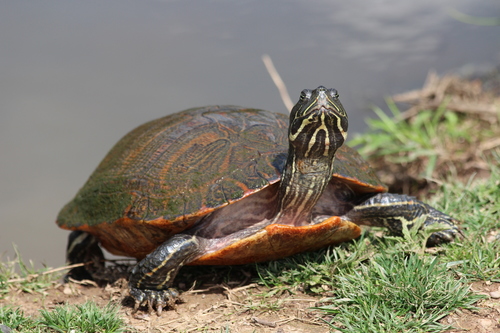
Nine species in the Graptemys genus can make it difficult to distinguish Graptemys pulchra (the Alabama map turtle) from other members of the genus.
Key Diagnostic Characteristics
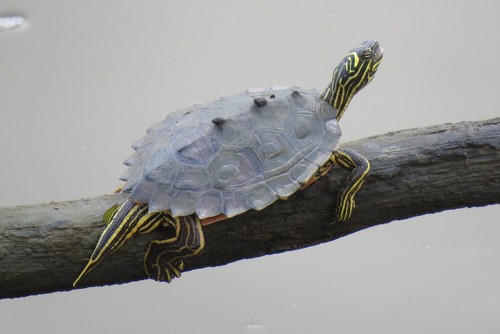
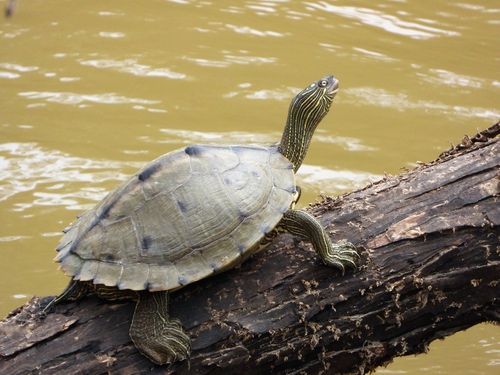
A small set of key diagnostic characteristics set this species apart: a distinct black stripe running down the center of its back, with knobs protruding from the stripe.
Adult Male Size and Coloration
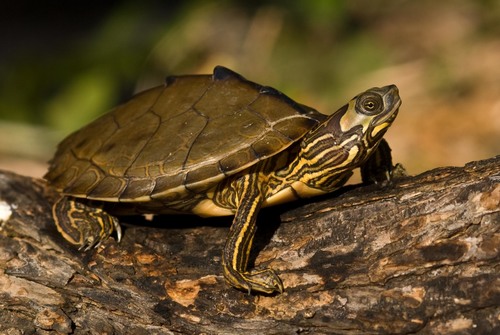
Adult males measure 9.0–12.7 cm (3.5–5.0 in) in straight-line carapace length, and they retain most of the coloration and pattern they had as juveniles.
Adult Female Size and Morphology
Adult females measure 18.0–29.2 cm (7.1–11.5 in), have extremely large heads adapted for crushing snails and mollusks, and lose most of their markings and patterns, becoming duller than juveniles and males.
Carapace Coloration
The carapace (upper shell) ranges in color from olive to dull green in adults, with a faintly visible black stripe; juveniles have a darker stripe on a more distinctly olive carapace.
Upper Shell Markings
The outermost edge of the upper shell usually has light reticulate markings, and the scutes (scale-like shell structures) each have a yellowish bar or semicircle. Dark rings are typically present on the lower surface of each outer scute.
Plastron Characteristics
The Alabama map turtle has a hingeless yellow plastron (lower shell) that is notched at the back, with a narrow black border along the edge of each plastron scute.
Head Markings
Its head is brown to olive, with a large light green to yellow marking located between and behind the eyes. Lateral and dorsal head stripes may be either continuous or separated, and chin stripes occur in transverse, longitudinal, or both arrangements.
Limb and Tail Features
Its feet are webbed, and its tail and limbs have stripes.
Growth Rate
Juvenile growth rate is rapid, but slows quickly once the turtle reaches maturity.
Lifespan and Female Maturation Age
Females reach full size around 23 years old, and can live 50 years or more in natural conditions.
Sexual Dimorphism
Females have noticeably larger jaws, while males have a long thick tail, with the vent located past the edge of the carapace.
Endemic Range
The Alabama map turtle is endemic to the Mobile Bay drainage basin in the Southeast United States, where it inhabits flowing (lotic) water areas of Alabama, Georgia, Florida, Mississippi, and possibly Louisiana. Its range extends east from the Pearl River (on the Mississippi-Louisiana border) to the Yellow River (on the Florida-Alabama border). The Alabama map turtle is endemic to major Gulf of Mexico drainage systems, covering the same range from the Pearl River east to the Yellow River.
Habitat Preferences by Age and Sex
Juveniles and males prefer shallow water with basking logs, while females prefer deeper water and particular coarseness in their sandbar habitat.
Fall Line Distribution Correlation
Tinkle noted a relationship between the species' abundance and distribution and the fall line.
Habitat Management Considerations
Managers can create optimal habitat for juveniles, adult males, and adult females by including the necessary habitat structure within river systems. Water temperature, specific river characteristics such as prey availability, geographic variation across different drainages, and any disease or parasite issues are all key to creating ideal habitat for the Alabama map turtle.
Seasonal Activity Patterns
Seasonal activity is primarily determined by water temperature: in one studied population, temperatures below 19 °C (66 °F) caused a severe decline in feeding and activity, but no complete population-wide hibernation occurred, and no significant interspecific competition with other turtle species was recorded.
Stream Habitat Requirements
Graptemys pulchra occurs mainly in large coastal plain streams that support large mollusk populations.
Geographical Variants
There are four recognized geographical variants, one each in the Pearl River drainage, Pascagoula drainage, Mobile Bay drainage, and the combined Escambia and Yellow River drainages.
Ectoparasite Records
No harmful parasitism has been recorded, though a single ectoparasite leech (Placobdella sp.) was found on a turtle in spring.
Intestinal Parasite Records
The most common intestinal parasite was an acanthocephalan (Neoechinorhynchu), found in less than 25% of the adult population. One adult female had a fluke (Telorchis sp.) in its small intestine, and a sporozoan (Myxidium chelonarum) was recorded in the bile duct and gall bladder of the Alabama map turtle.
Sexual Maturity Age
Male Alabama map turtles reach sexual maturity at three to four years old, while females do not reach maturity until around 14 years old.
Mating Behavior
Mating only occurs in autumn, though sperm is present in males year-round, so females may store sperm.
Courtship Behavior
The courtship sequence is similar to that of other aquatic emydine turtles, except that males use their snouts as titillation tools rather than extended fore claws; mature males of this species do not have enlarged fore claws at all.
Reproductive Output
Females lay an average of 29 eggs per season, with the number depending on the size of the female, and an average of four clutches per season per individual.
Nest Site Characteristics
Nests are located 1–20 m (3.3–65.6 ft) from the water's edge, primarily on exposed sandbars; by comparison, other Graptemys species nest up to 200 m (660 ft) from the water's edge. Sand coarseness plays a key role in nest site selection.
Incubation Parameters
At an incubation temperature of 29 °C (84 °F), incubation averages 74 to 79 days, and complete clutch infertility is common.
Nest Predators
Observed nest predators are fish crows during the day and raccoons at night.
Adult Threats
The main threats to adult Alabama map turtles are humans and the alligator snapping turtle (Macroclemys temmincki).