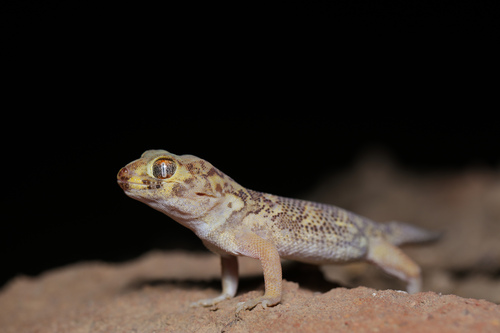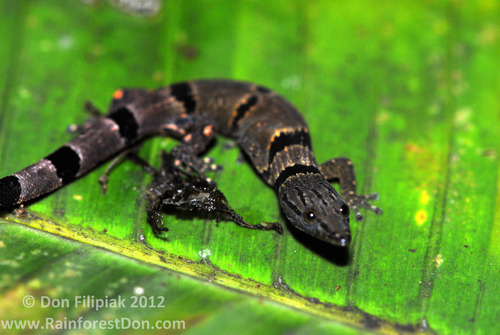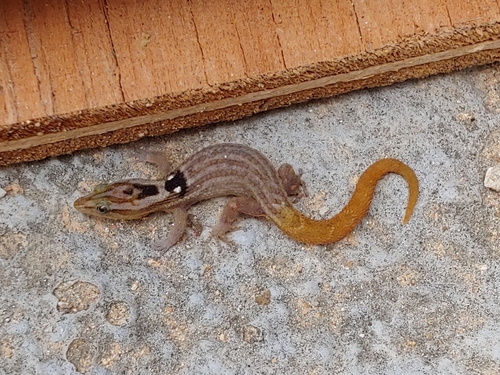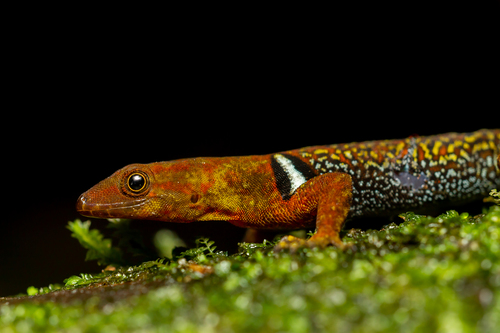
About Gonatodes albogularis (Duméril & Bibron, 1836)
Size
This species of gecko, Gonatodes albogularis, grows to a snout-vent length between 69–90 mm (2.7–3.5 in), with a reported maximum total length of 100 mm (3.9 in). Males have a larger average snout-vent length than females.
Sexual Dimorphism
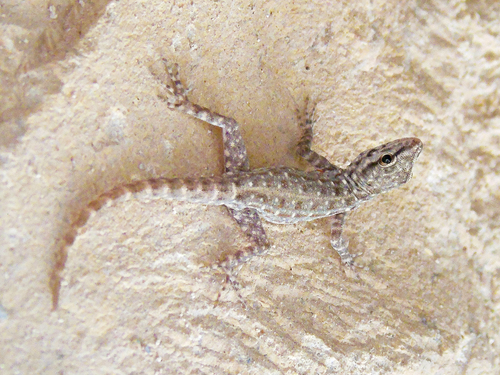
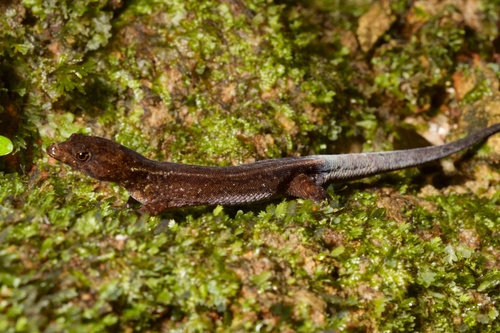
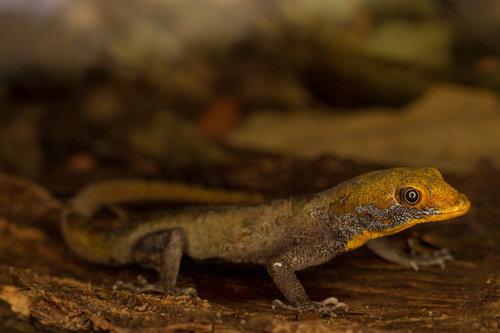
Like almost all species in the genus Gonatodes, this species is sexually dimorphic: males are colourful, with yellowish to orange heads and dark blue bodies, while females, juveniles, and young geckos have more drab colouration of greyish white or light brown across their heads and bodies.
Diagnostic Morphology
This species can also be identified by its round pupils, digits without extended lamellae, and lack of eyelids.
Sexual Maturity
Both males and females reach sexual maturity at the same size, at around 6 months of age, and can reproduce at any time of year.
Reproductive Physiology
Unlike many other geckos, G. albogularis does not accumulate fat in its abdomen, which indicates its reproductive ability is not tied to stored fat stores and is instead driven by other factors.
Activity and Territoriality
G. albogularis is a diurnal, territorial lizard. It primarily defends its territory through tail waving and other territorial behaviours.
Diet and Activity Pattern
It feeds mainly on insects and spiders, and is active during the day while avoiding direct exposure to sunlight.
General Habitat
It is most often found in dry habitats, though it has also been observed in moist habitats, with a preference for tropical dry forest, forest edges, and anthropogenic habitats.
Haiti Habitat Associations
In Haiti, it is considered edificarian, meaning it prefers to live on human buildings, and it is sometimes found indoors, leading to frequent interactions with humans in occupied areas.
Egg Laying
Females lay only one egg at a time, and prefer to lay eggs in communal nesting sites to increase hatching success and gain extra protection from predators.
Breeding Season Variation
While the species can breed year-round with multiple offspring per year and no strict preferential breeding season, a study in Panama observed seasonal egg-laying, with more eggs laid during the rainy season.
Subspecies Overview
Four subspecies are generally recognized, with some unassigned populations across Central America.
Nominate Subspecies Distribution
The nominate subspecies, Gonatodes albogularis albogularis, is distributed across the Lesser Antilles, northern Colombia (Valle del Cauca, Chocó, La Guajira), and Venezuela. In Venezuela, it occurs in coastal mainland ecoregions, coastal islands, the lowlands around Lake Maracaibo, the Cordillera de Mérida, the Serranía del Perijá, the hills of Lara and Falcón, and the Orinoco Delta; it is absent from the central Llanos plains, the southern Amazon rainforest, and the eastern Guyana Shield, which make up most of Venezuela’s total territory.
Lesser Antilles Distribution
In the Lesser Antilles, it is found on Aruba and Curaçao, where it is particularly common in central Curaçao around the old Daniël and Siberië plantations. One researcher, Hummelinck, proposed that this species’ presence on these two islands is not natural, and that the populations there are introduced.
Historical Distribution Records
The first supposed specimens of the nominate subspecies were collected on Martinique in the early 19th century, but the species has never been collected again from that island. Some historical records from Trinidad and Tobago exist, but as of 2018 these are considered erroneous, resulting from misidentification with the extremely common local species Gonatodes vittatus.
Cuba Introductions
Some sources state the nominate subspecies’ syntypes were collected in Cuba, and the nominate subspecies is also thought to have been introduced to Cuba.
Florida Introductions
The species has been introduced to Florida in the United States, where it remains established; it most likely spread from Key West to other parts of southern Florida, and research indicates it has been present in Florida since 1929, with the first documented published sighting in 1934.
Gonatodes albogularis bodinii Taxonomy
Gonatodes albogularis bodinii was first collected in the early 1960s on Monje Grande del Sur, Venezuela. This subspecies is endemic to the Los Monjes Archipelago, where it occurs on both Monje Grande del Sur and Monje Grande del Norte.
Gonatodes albogularis fuscus Taxonomy
Gonatodes albogularis fuscus was first collected in Nicaragua, likely at the port town of El Rama; as of 1988, its holotype is considered missing.
Gonatodes albogularis fuscus Distribution
This subspecies is distributed across Nicaragua, Panama, Costa Rica, El Salvador, western Colombia, and Cuba, including Cayo Santa María. It was first collected near Miami, Florida in 1934, and was thought to have spread from the Florida Keys, though the first specimen from the Keys was not collected until 1939.
Gonatodes albogularis fuscus Florida Status
It may have been transported from the Keys to other parts of southern Florida in the early 20th century, but it appears to have either naturally died out across the Florida mainland or never established a persistent breeding population there. The last collected specimen from Key West was taken in 1989, and the last recorded sighting in Key West was in 1995. Targeted monitoring by specialist gecko herpetologists across southern Florida from 1995 to 2005 found no evidence that this subspecies remains extant in the region.
Gonatodes albogularis notatus Taxonomy
Gonatodes albogularis notatus was most likely first collected in Aquin, Haiti; in 1988, researchers Schartz and Henderson published a long list of different type localities across Haiti for the single type specimen.
Gonatodes albogularis notatus Distribution
This subspecies is found on Jamaica, Grand Cayman Island, Îlet à Cabrit (part of France’s Guadeloupe archipelago), and Hispaniola. It has been recorded at altitudes ranging from sea level to 910 m (3,000 ft).
Hispaniola Distribution
On Hispaniola, it occurs primarily in coastal areas, and as of 1980 it had only been found in western Haiti, with no records from eastern Haiti or any part of the Dominican Republic. It is widespread across Haiti’s Tiburon Peninsula, and also occurs on the Plaine du Cul-de-Sac, along the northern shore of the Gulf of Gonâve north to the city of Gonaïves, including on Ile de Gonâve.
Unassigned Populations
Populations of G. albogularis have been recorded in Mexico (Chiapas, Veracruz), Guatemala, and Honduras, but it is unclear which subspecies these populations belong to. The species has been reported to occur in Belize, but no confirmed records from the country exist.
Cuba Subspecies Summary
Both the nominate subspecies and G. a. fuscus have been reported from Cuba, and the species as a whole is considered introduced to the island, with the related subspecies G. a. notatus found on surrounding Caribbean islands.