About Gomphrena globosa L.
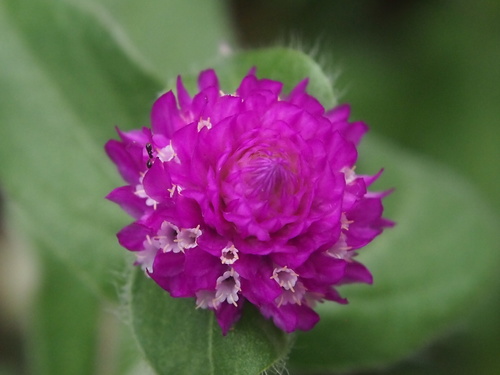
Gomphrena globosa, commonly called globe amaranth, is an edible plant in the Amaranthaceae family. Its most visually prominent feature is its round-shaped flower inflorescences; cultivated varieties have been bred to produce blooms in shades of magenta, purple, red, orange, white, pink, and lilac. The actual true flowers that grow within these large flowerheads are small and not easily noticeable. Globe amaranth is native to Central America, specifically including Panama and Guatemala, but is now cultivated across the world. As a tropical annual plant, it blooms continuously from summer through early fall. It is highly tolerant of heat and fairly resistant to drought, but grows best when planted in full sun and given regular moisture. This species fixes carbon through the C4 photosynthetic pathway. When fully mature, its flowerheads are roughly 4 centimetres (1.6 inches) long, and the entire plant can reach up to 24 inches (61 centimetres) in height. Gomphrena globosa is an outcrossing species pollinated by butterflies, bees, and other insects. Floral volatiles are thought to play an important role in the species’ reproductive success by helping attract pollinators. In Hawaii, globe amaranth is commonly used to make long-lasting leis, because it retains both its shape and color after drying. In Nepal, this flower is known locally as makhamali ful, and it is used to create garlands for Bhai Tika, the final day of the Tihar festival. Sisters place this garland around their brothers’ necks to grant protection. The flower’s slow withering trait symbolizes a long lifespan for the brother. In 1855, Jung Bahadur Rana included this flower in a gift sent to Britain. In Sanskrit, this flower is called Rakta Mallika. Globe amaranth is commonly used in landscape design and cutting gardens, valued for its bright colors and good color retention. As an edible plant, G. globosa has a history of use in herbal medicine. Its flowers contain high amounts of betacyanins, which have a wide variety of uses as additives and supplements in the food industry, cosmetics, and livestock feed. Betacyanins from globe amaranth remain stable between pH 3 and pH 7, making them well suited for use as a natural red-violet food dye.