About Glottiphyllum depressum (Haw.) N.E.Br.
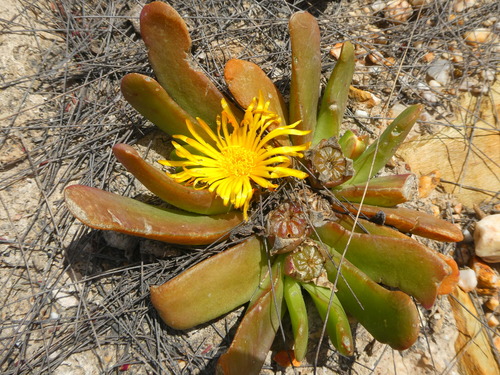
Glottiphyllum depressum (Haw.) N.E.Br. can be distinguished from closely related species by several key characteristics. Many of its leaves have a hooked shape at their tip; this distinct hook forms because the opposite leaf presses against it when the leaf pair first emerges. The cell walls of the leaf bladder cells are also noticeably wavy. Both its flowers and fruits lack long stalks, so they grow held close to the body of the plant. Its seed capsule has a very soft, round, spongy base, and thick valves that form a raised rounded dome more than 3 mm high at the capsule's top. The rim surrounding the capsule is low and depressed. The capsule stalks disintegrate quickly, which lets the capsule fall away from the plant. The rounded capsule then rolls, spreading seeds further in a dispersal method called tumble fruit. Like many other species in the Glottiphyllum genus, G. depressum has stems that grow horizontally along the ground, with its green, fleshy leaves arranged in two opposite rows, an arrangement called distichous. This species is widespread in Western Cape Province, South Africa, where it occurs from the Ceres Karoo, across the Overberg region, and extends eastwards.