About Carpobrotus acinaciformis (L.) L.Bolus
Genus Growth Habit
All species of the Carpobrotus genus, commonly called "sour fig", grow as sprawling succulent groundcovers.
Flower Color
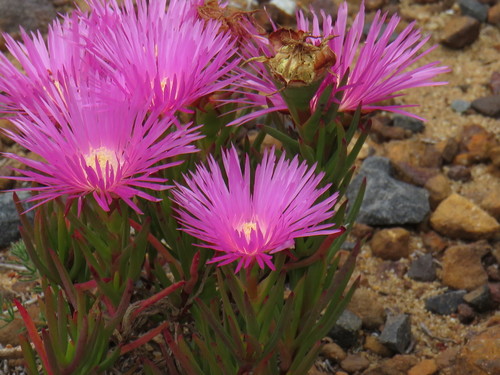
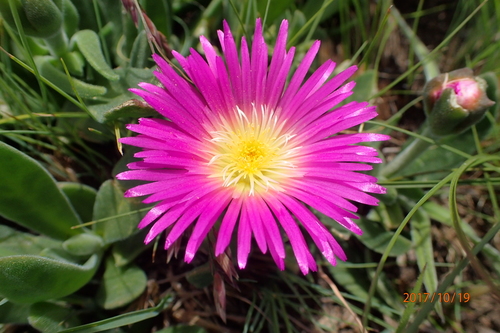
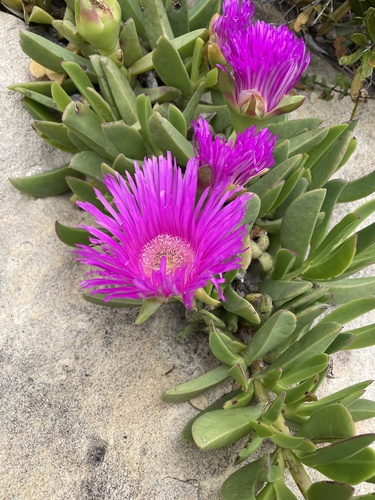
Carpobrotus acinaciformis has bright pink-purple flowers.
Calyx Lobes
It bears five short calyx lobes that are all relatively similar in length, which differs from the calyx lobes of the related species C. edulis.
Receptacle Shape
The receptacle is mostly sub-globose, rarely slightly oblong, and tapers only gently where it connects to the stalk.
Ovary Structure
The top of the ovary is often slightly depressed in its center.
Leaf Shape
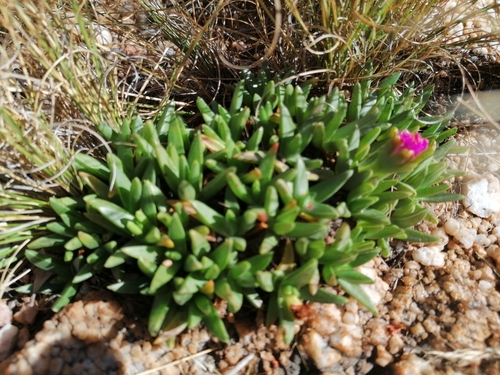
The leaves of C. acinaciformis are stout, scimitar-shaped (the trait that gives the species its epithet acinaciform), and form an isosceles triangle in cross-section when cut perpendicularly.
Leaf Coloration
Their color is a dull glaucous-green, sometimes with reddish edges or angles.
Native Endemic Range
This species is naturally endemic to the Western Cape, South Africa.
Coastal Habitat Range
Its natural native habitat is coastal dunes, ranging from as far north as Melkbosstrand, across the Cape Peninsula, and eastward to near Mossel Bay.
Inland Form Distribution
A more compact, rarer form of the species also grows inland, from Cape Town eastward to Riversdale.
Eastern Range Transition
East of its natural range (east of Mossel Bay), C. acinaciformis transitions into the related species Carpobrotus deliciosus.
Western Range Transition
West and north of its natural range (north of Melkbosstrand in Cape Town), it transitions into the related species Carpobrotus quadrifidus.
Ornamental Cultivation
C. acinaciformis has very showy pink or purple flowers, so it is frequently cultivated, especially in mild coastal climates.
Human Fruit Uses
Its fruits are edible, and people in southern Africa use them to make a traditional jam.
Wildlife Fruit Consumption
In the wild, the fruits are grazed by tortoises and other southern African herbivores.
Non-Native Invasion Status
In some areas outside its native range, such as south-west England, C. acinaciformis has become naturalised on sea cliffs and can outcompete native plant species.
Common Name Etymology
Its common name "Sally-my-handsome" comes from its former classification in the genus Mesembryanthemum.