About Geomys texensis Merriam, 1895
Common Name and Visual Similarity
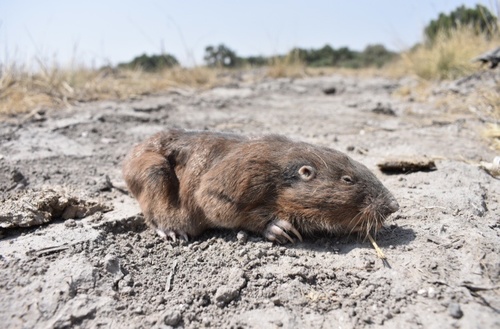
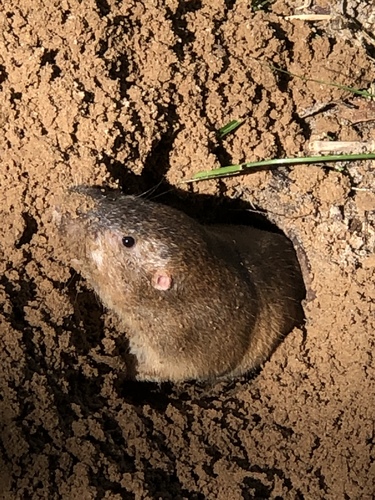
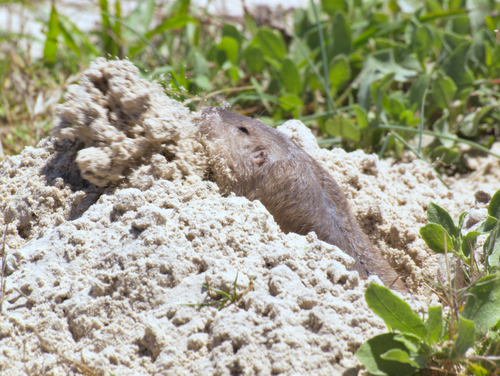
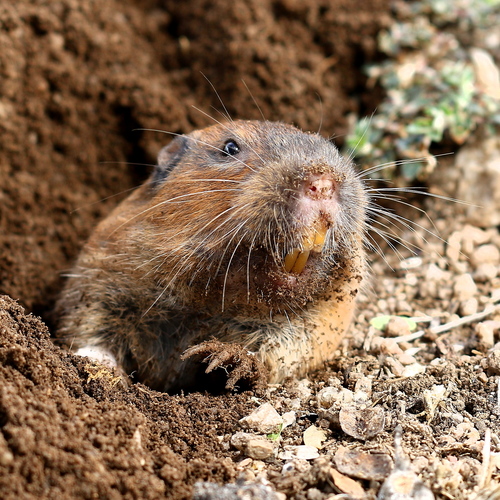
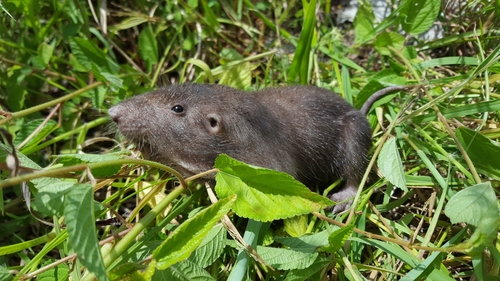
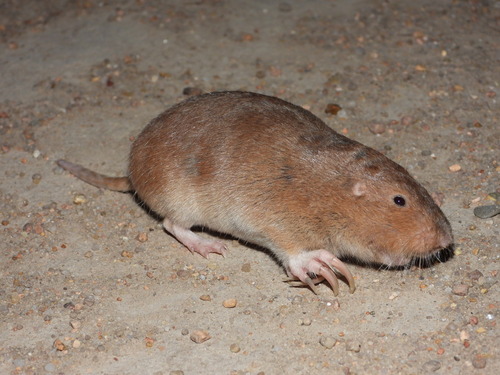
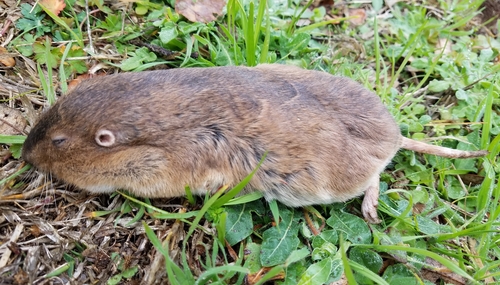
Geomys texensis, commonly called the central Texas pocket gopher, is very similar in appearance to its close relatives, the plains pocket gopher and Knox Jones's pocket gopher, and the three species can be difficult to distinguish visually.
Body Size
Males of this species average 18 cm (7.1 in) in total length, while females average 15 cm (5.9 in); both sexes have a tail that measures approximately 6 to 7 cm (2.4 to 2.8 in) long.
Fur Coloration
Most of the body is covered in brownish fur, with a paler yellowish collar around the throat, and white underparts and feet.
Seasonal Coat Variation
The winter coat is darker than the summer coat, and the underparts may sometimes take on a pale grey color in winter.
Cranial Morphology Challenges
There is a lack of cranial morphological differentiation between G. texensis and its sibling species, which has created problems for scientists trying to unambiguously confirm the physical characteristics unique to G. texensis.
Morphological Similarity Causes
Scientists postulate that conservation of morphological traits adapted for a fossorial, burrowing lifestyle is one reason G. texensis and its sibling pocket gopher species look so similar.
Genetic Research Need
Genetic isolation between these species is rarely accompanied by corresponding morphological evolution, so a more comprehensive understanding of the genetic makeup of G. texensis and its close relatives is needed.
General Distribution
Geomys texensis is primarily found in central Texas.
County Range Details
Northern populations live across stretches of McCulloch, San Saba, and Lampasas counties, and the species range extends south to Zavala, Frio, and Medina counties.
Recognized Subspecies
The three recognized subspecies of G. texensis are G. t. llanensis, G. t. texensis, and G. t. bakeri, which fall into several genetic clades across the species range and are generally grouped as either northern-dwelling or southern-dwelling.
Northern Subspecies Distribution
The two northern subspecies, G. t. texensis and G. t. llanesis, have parapatric distributions: their ranges do not overlap, but are immediately adjacent to one another.
Southern Subspecies Distribution
The third subspecies, G. t. bakeri, is geographically isolated from the other two subspecies and is primarily found in the southern counties of Medina, Uvalde, and Zavala.
Subspecies Segregation Research
Researchers have recently highlighted the significant geographic segregation between the three subspecies, and are currently investigating the genetic implications of this habitat range separation.
Current Research Focus
Current research focuses particularly on examining genetic differences between the northern-dwelling G. t. texensis and G. t. llanesis, and the southern-dwelling G. t. bakeri.