About Geomys breviceps Baird, 1855
Size and Shape
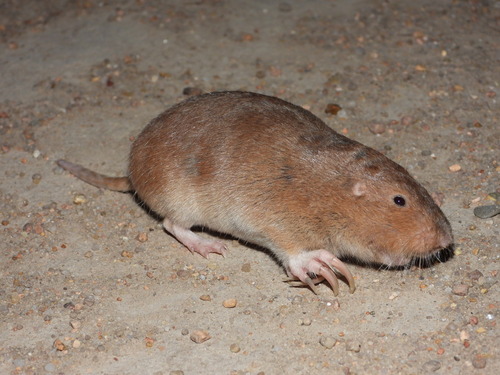
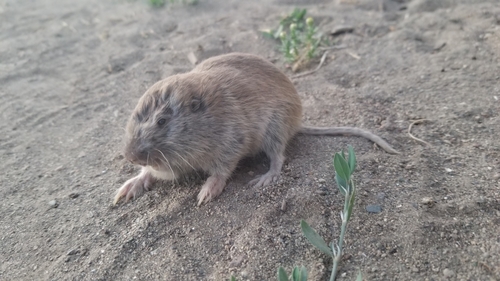
Baird's pocket gopher (Geomys breviceps Baird, 1855) is a small-to-medium sized rodent in the pocket gopher group. It has a cylindrical body, with most of its weight concentrated near the head and the heaviest part of the body located on the back of the neck, which is slightly thinner than the upper body.
Skull and Face
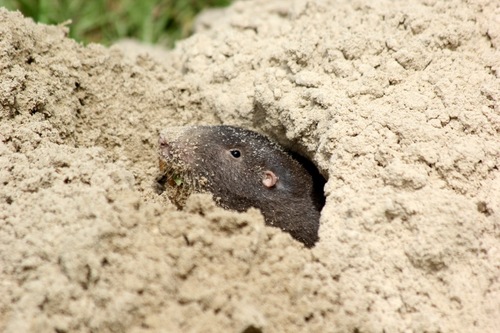
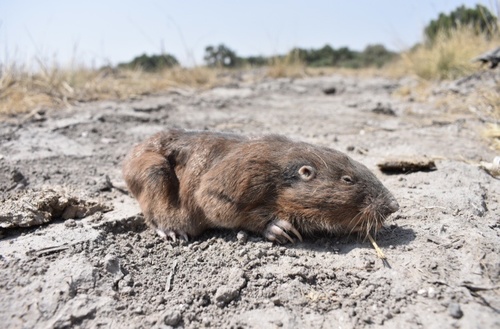
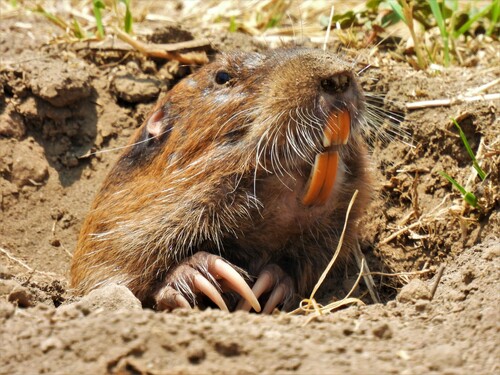
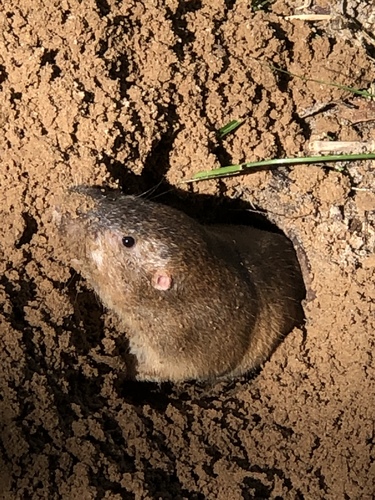
Its zygomatic arch is shorter than the width of the mouth, so the dorsal region of the skull extends past the jugal bone. The eyes are very small and bead-like, and the ears are only marked by a small flap of skin along the top of the temple. It has fur-lined cheek pouches that it uses to carry food.
Fur and Limbs
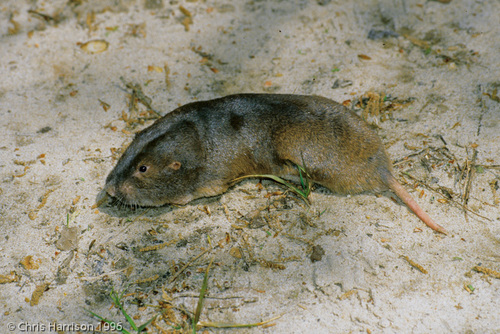
The body tapers gradually from the head to the tail, and widens slightly at the thighs. The entire body is covered in short fur that ranges in color from pale brown to black, and is typically paler on the belly. The tail is short, thick, and mostly hairless, with only a small amount of hair at the base, and averages 65 mm (2.6 in) long. Its front feet are adapted for digging and have long curved claws; the rear feet are smaller, with an average length of 31 mm (1.2 in).
Similar Species
This species looks identical to G. attwateri and G. bursarius, and can only be told apart by genetic testing and geographic range. Males average 180–200 g (6.3–7.1 oz) in weight, with a 19 mm (0.75 in) long cranium; females average 120–160 g (4.2–5.6 oz) in weight, also with a 19 mm (0.75 in) long cranium.
Geographic Range
Baird's pocket gopher is most commonly found on the Gulf Coastal Plains of eastern Texas, where it occupies three different soil types. It occurs in fine sandy Lufkin and Ochlocknee soil types, where topsoil depth is less than 10 centimetres (3.9 in). It is not typically found in the third soil type, Wilson sandy loam, which hardens and compacts when it dries. G. breviceps does not tend to live in dense clay soils or soils with high moisture content.
Burrow Systems
This species is solitary and lives underground, where it creates complex burrow systems that serve as its primary habitat. Gophers only leave their burrows during wet months to avoid flooding. On average, each burrow is 6 cm (2.4 in) in diameter, sits 10–68 cm (3.9–26.8 in) underground, and is occupied by only one adult gopher. Burrow systems range from 55–180 cm (22–71 in) in length, and contain feeding galleries, a nesting chamber, a latrine area, and food storage chambers.
Winter Mounds
During the winter, G. breviceps builds globular mounds above ground that can measure up to 1.8 m (71 in) in diameter.