About Gavia arctica (Linnaeus, 1758)
Taxonomic Naming
This species is the black-throated loon, with the scientific name Gavia arctica (Linnaeus, 1758).
Adult Size and Weight
Adult black-throated loons measure 58 to 73 cm (23 to 29 in) in length, have a wingspan of 100 to 130 cm (39 to 51 in), and weigh 1.3 to 3.4 kilograms (2.9 to 7.5 lb).
Nominate Breeding Head & Neck
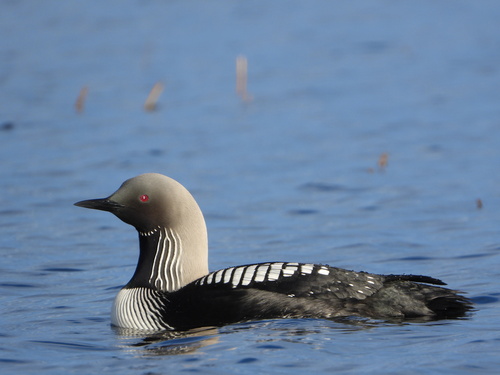
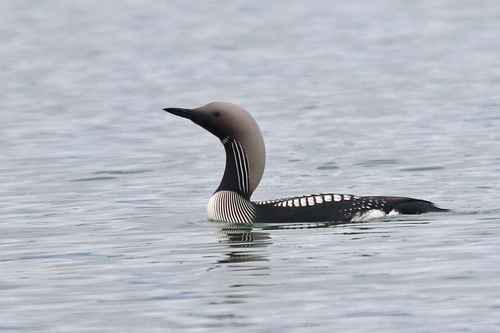
In breeding plumage, the nominate subspecies has a grey head and hindneck, with a black throat and a large black patch on the foreneck; both the throat and foreneck patch have a soft purple gloss. The lower throat features a necklace-shaped patch made of short parallel white lines.
Nominate Breeding Underparts
On the sides of the throat, there are around five long parallel white lines that start from the edge of the lower throat patch and extend down to the chest, which also has a pattern of parallel white and black lines. The rest of the underparts, including the center of the chest, are pure white.
Nominate Breeding Upperparts
The upperparts are blackish down to the base of the wing; a few rows of high-contrast white squares cover the mantle and scapulars.
Nominate Breeding Wing Features
Small white spots appear on both the lesser and median wing coverts, while the rest of the upperwing is blackish. The underwing is paler than the upperwing, and the underwing coverts are white.
Bill, Limbs, Tail & Iris
The tail is blackish. The bill and legs are black, with the inner half of the legs pale grey. The toes are grey, and the webbing between the toes is also grey with an additional flesh colour. The irises are deep brown-red.
Sexual Dimorphism
The sexes are identical in appearance.
Viridigularis Subspecies Traits
The subspecies viridigularis is very similar to the nominate subspecies, except it has a green throat patch instead of a black one. It still has a purplish gloss, though the gloss is less intense than that of the nominate subspecies.
Non-Breeding Adult Head & Back
Non-breeding adults differ from breeding adults by having more brownish caps and back of the neck. Non-breeding adults also lack the patterned upperparts of breeding adults, though some upperwing coverts keep their white spots, so the upperparts appear almost unpatterned black when viewed from above.
Non-Breeding Adult Throat Markings
The sides of the throat are usually darker at the white border that separates them from the front of the throat, and a thin dark necklace is usually visible between these two areas. There is white colouring on the sides of the head, below the eye.
Non-Breeding Adult Bill Trait
The bill is steel-grey with a blackish tip, the same as in breeding adults.
Juvenile Overall Appearance
Juveniles are similar to non-breeding adults, but have an overall browner appearance. They have buffy scaling on the upperparts that is particularly distinct on the scapulars.
Juvenile Specific Markings
The lower face and front of the neck have a diffused brownish tinge. Juveniles do not have white spots on the wing coverts, and their irises are darker and duller than those of adults.
Hatchling Appearance
Newly hatched chicks are covered in down feathers that range from sooty-brown to brownish-grey, and usually have a slightly paler head. The abdomen of the chick is pale.
Similar Species Distinction
The black-throated loon can be told apart from the Pacific loon by the white colouring on the flanks of the black-throated loon.
Breeding Range
The black-throated loon has a large geographic range. It breeds across northern Europe, Asia, and the Seward Peninsula in Alaska.
Breeding Habitat
When breeding, it occurs around isolated, deep freshwater lakes that are larger than 0.1 square kilometres (0.039 mi²), and it especially favors lakes with inlets, since it prefers to only have small stretches of open water.
Wintering Range
When not breeding, this loon migrates generally southward to ice-free seas. It typically winters on coasts of the north-east Atlantic Ocean, and on coasts of the eastern and western Pacific Ocean, including the coasts of Japan.
Non-Breeding Habitat
During the non-breeding season, it usually inhabits inshore waters along sheltered coasts, though it can sometimes be found further inland, in bodies of water such as the Mediterranean and Black seas.