About Garrulax taewanus Swinhoe, 1859
Taxonomic Classification
The Taiwan hwamei (Garrulax taewanus) is a passerine bird that belongs to the family Leiothrichidae.
Discovery and Endemism
This species was first described by Robert Swinhoe in 1859, and it is endemic to the island of Taiwan.
Taxonomic History
It was previously classified as a subspecies of the Chinese hwamei (Garrulax canorus), but has since been recognized as a separate species.
Divergence Estimate
Estimates indicate it diverged from the Chinese hwamei roughly 1.5 million years ago.
Size
It reaches approximately 24 centimeters in total length.
Plumage Characteristics
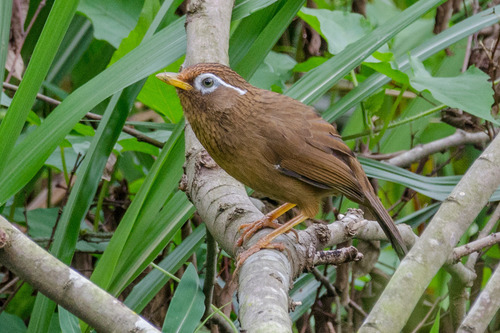
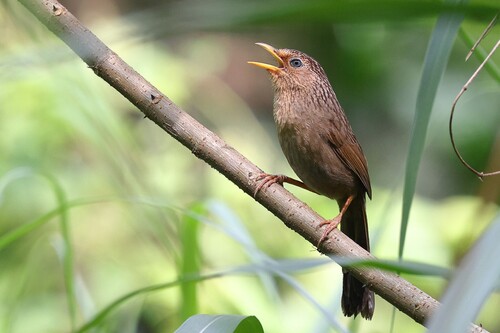
Its plumage is primarily grey-brown, with heavy streaking across the crown, nape and back, and fine streaking across most of its underparts.
Plumage Comparison to Chinese Hwamei
Unlike the Chinese hwamei, it does not have the characteristic white eye markings; Chinese hwamei are also more rufous in overall color and have less heavy streaking than the Taiwan hwamei.
Vocalization
Its song consists of long, melodious, varied whistles.
Habitat
It lives in secondary woodland found in foothills and lower mountain areas, up to 1,200 meters above sea level.
Foraging Behavior and Diet
It forages alone, in pairs, or in small groups, searching through the understorey to feed on insects and seeds.
Population Trend and Size
Its population is currently declining, and numbers are estimated to be between 1,000 and 10,000 mature individuals.
Conservation Status
BirdLife International classifies this species as near threatened.
Threats
While habitat loss may impact its population size, the primary threat it faces is hybridization with introduced populations of the Chinese hwamei.