About Galinsoga quadriradiata Ruiz & Pav.
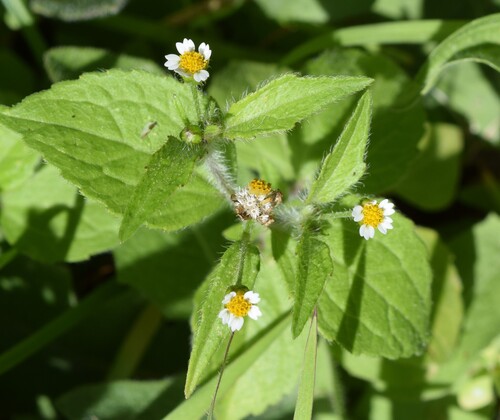
Shaggy soldier (Galinsoga quadriradiata Ruiz & Pav.) is an annual herb that typically reaches around 25 cm (10 inches) tall, and can exceptionally grow up to 80 cm tall. It has opposite leaves, and is so highly branched that it produces two side shoots at nearly every node. Stems, leaves, and bracts range from sparsely to densely hairy, with a mix of glandular and simple hairs. Lower leaves are ovate, toothed, and around 5 cm long, occasionally reaching 9 cm; upper leaves are smaller and more lanceolate in shape. All leaves have petioles around 1 cm long and lack stipules. A typical plant produces numerous flower heads arranged in groups of three, a structure formally called dichasial cymes, with 2 cm long peduncles at the tip of every branch. Each flower head is around 5 mm across, and contains about 25 tiny 3 mm yellow five-lobed disc florets, plus five larger, widely spaced 5 mm petal-like white ray florets that have 2 or 3 crenate teeth. Both disc and ray florets are fertile: disc florets are bisexual, while ray florets are female. Shaggy soldier is typically a hairy plant, while the otherwise similar gallant soldier is usually more or less hairless, but this difference is not enough for accurate identification. For confident identification, use a hand lens to check that shaggy soldier has simple, unforked scales on its receptacle, and pappus scales with hairy margins and a long thin point at the top. Galinsoga quadriradiata and its close relative Galinsoga parviflora are both edible. They can be used as a pot herb or added to salads, but outside their native range they have not been widely adopted as a culinary ingredient except in China. Galinsoga parviflora is preferred as a salad green because it has non-hairy leaves. People living in tropical regions must take care not to confuse these species with the distantly related, visually similar Tridax procumbens.