About Galago senegalensis É.Geoffroy Saint-Hilaire, 1796
Common Names and Taxonomy
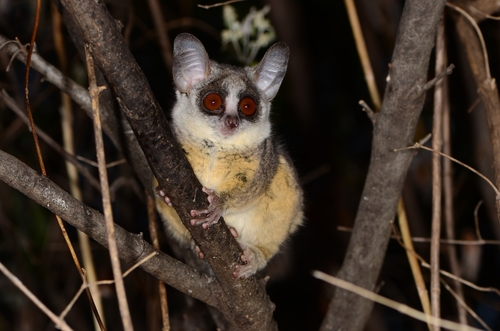
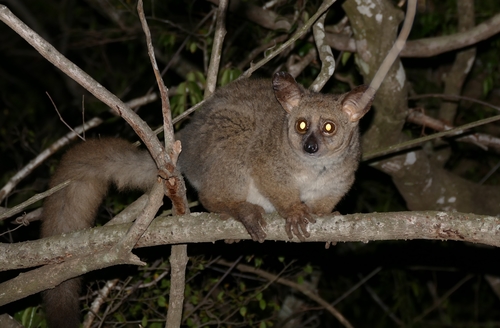
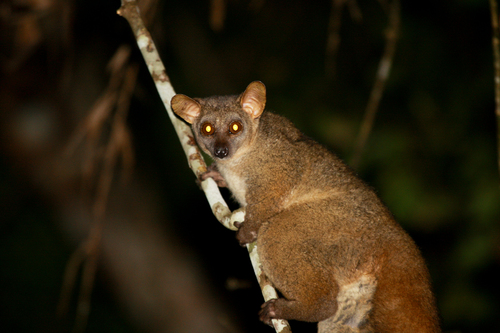
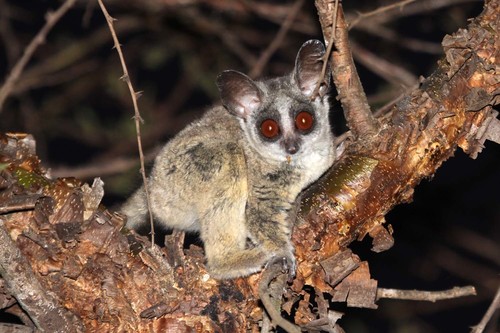
Galago senegalensis, commonly called the Senegal bushbaby, Senegal galago, lesser galago, or lesser bush baby, is a small nocturnal primate belonging to the galago family Galagidae. The common name "bush baby" is thought to originate either from the species' cries or from its appearance.
Locomotion
This species is an agile leaper and runs swiftly along tree branches.
Distribution and Habitat
Its range covers Africa south of the Sahara, as well as nearby islands including Zanzibar, and it typically inhabits dry woodland and savannah regions.
Size and Fur
It is a small primate, measuring around 130 mm in length and weighing 95 to 300 grams, with thick, woolly fur that ranges in color from silvery grey to dark brown.
Key Morphological Features
It has large eyes that support strong night vision, strong hind limbs, and a long tail that aids with balance.
Auditory Adaptations
Its ears have four individual segments that can each bend back independently, improving hearing while it hunts insects at night.
Diet
It is omnivorous, with a diet that includes small animals such as birds and insects, plus fruit, seeds, flowers, eggs, nuts, and tree gums.
Reproductive Timing
Senegal bushbabies reproduce twice each year, once at the start of the rainy season in November and once at the end of the rainy season in February.
Mating System and Nesting
The species is polygynous; females build leaf nests to raise their young.
Litter and Gestation
Litters contain 1 to 2 offspring, and the gestation period lasts 110 to 120 days.
Newborn Traits
Newborn bushbabies are born with half-closed eyes and cannot move independently.
Infant Care
After a few days, the mother carries her infant in her mouth, and leaves the infant on a convenient branch while she feeds.
Female Territoriality
Adult females maintain individual territories, but share these territories with their offspring.
Dispersal and Social Groups
Males leave their mother's territory after reaching puberty, while females stay, forming social groups made up of closely related females and their immature young.
Male Territoriality and Mating
Adult males hold separate territories that overlap with the territories of female social groups; usually, a single adult male mates with all the females in a given area.
Bachelor Groups
Males that have not established their own territories sometimes form small bachelor groups.
Communication Methods
Senegal bushbabies communicate with one another through calls and by marking their paths with urine.
Roosting Behavior
At the end of each night, all members of a group use a specific rallying call to gather before sleeping together in a leaf nest, a cluster of branches, or a tree hollow.