About Galago moholi A.Smith, 1836
Description
Physical Dimensions
The Mohol bushbaby (Galago moholi) is a medium-sized species with a head-and-body length of 15 cm (6 in) and a tail length of 23 cm (9 in).
Head Features
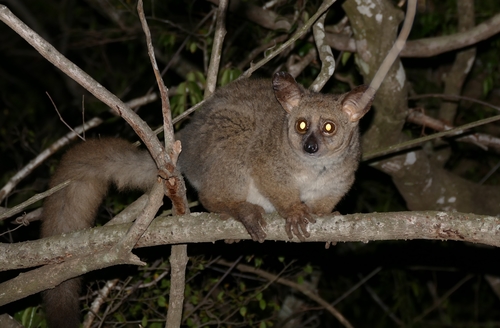
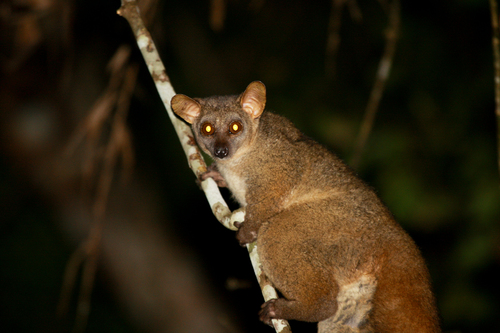
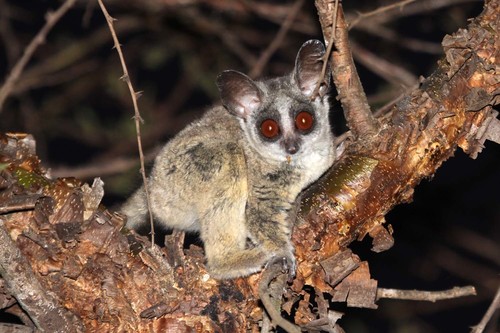
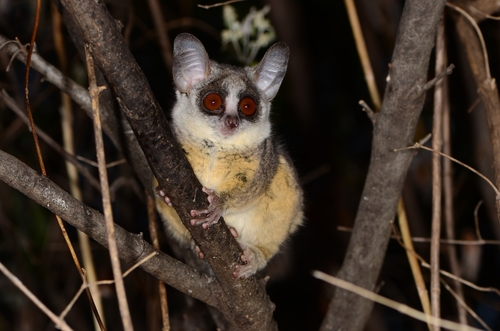
It has a broad head, a short muzzle, orange eyes, and diamond-shaped black eye-rings. A whitish stripe runs down its nose, and its large ears are grey.
Fur and Body Coloration
The dorsal surface of the body has greyish-brown fur, while the underparts are white, sometimes with a faint yellowish tinge. The flanks, insides of the limbs, hands, and feet are yellowish, and the fingers and toes have spatulate tips.
Tail Characteristics
Its tail is darker than the rest of its fur and not very bushy.
Range
Confirmed Distribution
This species occurs in Angola, Botswana, the Democratic Republic of the Congo, Malawi, Mozambique, Namibia, South Africa, Eswatini, Tanzania, Zambia, and Zimbabwe.
Possible Distribution
It may also be present in Rwanda and Burundi.
Habitat
Native Range Habitats
In its natural range, the Mohol bushbaby inhabits savanna, miombo woodland, mopane woodland, and riverine gallery forests. Within these biomes, it uses Acacia and Mopane trees for resting, breeding, food, and water, living in groups of two to seven among the trees' thorny branches.
Urban Populations
Breeding populations of Mohol bushbabies also exist in the suburbs of Johannesburg and Pretoria, South Africa; some of these populations originated from escaped or released pets, while others are made up of individuals that migrated from warmer regions.
Ecology
Primary Diet Components
The Mohol bushbaby feeds predominantly on insects and tree gum. The gum it consumes is an exudate from Acacia trees that oozes out of punctures made by insects, and its most favoured gum-producing trees are sweet thorn (Vachellia karroo, formerly Acacia karroo) and umbrella thorn (Vachellia tortilis, formerly Acacia tortilis).
Seasonal Foraging Patterns
In winter, Mohol bushbabies travel between gum trees across the ground; in the wet summer season, they usually move through the trees, and invertebrates make up a much larger proportion of their diet.
Feeding Timing
Feeding occurs shortly after sunset, with sporadic additional feeding throughout the night.
Water Intake
The Mohol bushbaby obtains most of its water hygroscopically from its solid food, and can survive without relying on standalone water sources.