About Galactia volubilis (L.) Britton
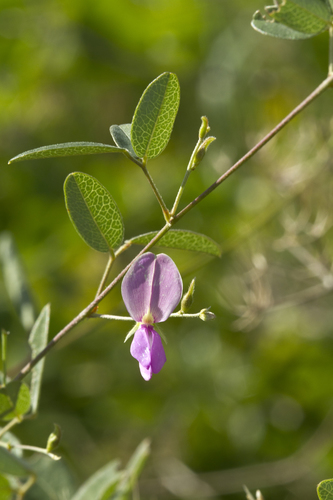
Galactia volubilis (L.) Britton has stems 0.4 to 1.2 meters long, with texture ranging from minutely hairy to almost smooth. Its leaves are typically 3-foliolate, bearing oblong to elliptic leaflets 2–3.5 cm long; leaflets are hairless on the upper surface and slightly hairy on the lower surface. Flowers are reddish purple, arranged in axillary racemes that are 1–13 cm long. Each flower is subtended by small bracts and grows on a short, hairy pedicel. The calyx is sparsely hairy, with lobes that are longer than the calyx tube. The legume is 2–5 cm long, linear, and densely hairy; it splits open at maturity with twisting valves to release its seeds. Like other species in the genus Galactia, this plant has papilionaceous flowers, diadelphous stamens, and produces elongated, dehiscent pods. Galactia volubilis occurs in xeric areas that have hot, wet summers and mild, dry winters. Its distribution extends from southeastern Virginia south to South Florida, and west to central Arkansas and eastern Texas. It grows in longleaf pine sandhills, as well as other dry forests and open areas. Galactia volubilis readily germinates from seed and resprouts after fire. It has been observed to become more abundant following fire, though this increase may be caused by fire’s heat-shock encouraging germination, rather than being a direct effect of fire itself.