About Dillwynia phylicoides A.Cunn.
Nomenclature and Habit
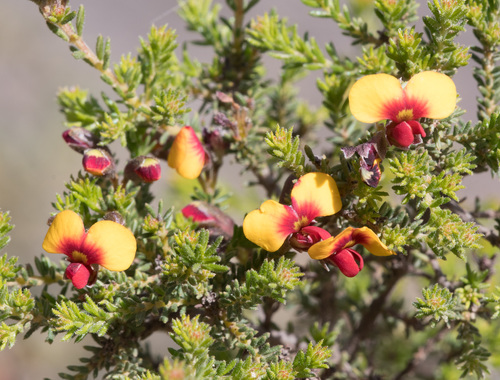
Dillwynia phylicoides A.Cunn., commonly called small-leaf parrot-pea, is an erect to open shrub that typically reaches a maximum height of 1.5 meters (4 feet 11 inches). Its stems are covered in stiff, spreading hairs.
Leaf Morphology
The leaves of this species are twisted, shaped from linear to narrow oblong, 3–8 mm (0.12–0.31 in) long and about 0.5 mm (0.020 in) wide, borne on a petiole 0.2–0.5 mm (0.0079–0.0197 in) long.
Inflorescence Arrangement
Flowers are arranged either singly or in clusters of up to eight, located in leaf axils near the ends of branchlets. They grow on a pedicel 1–2 mm (0.039–0.079 in) long, with bracts and bracteoles 1–2 mm (0.039–0.079 in) long.
Sepal Characteristics
The sepals are 4–6 mm (0.16–0.24 in) long and have stiff hairs on their outer surface.
Petal Morphology
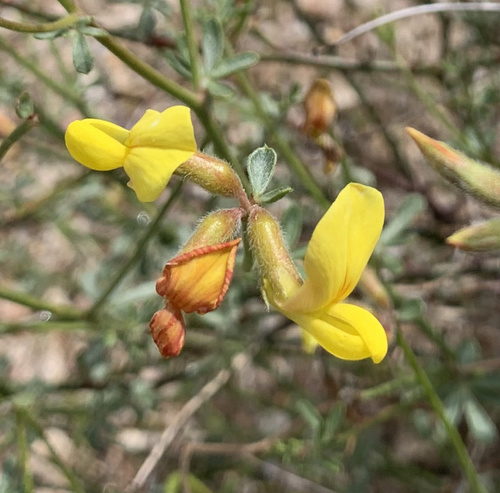
The standard petal is 7–12 mm (0.28–0.47 in) long and yellow with red veins. The wings are yellow and red, shorter than the standard petal, and the keel is orange to purplish-brown.
Flowering and Fruit
Flowering takes place from September to December, and the fruit is an oval pod 4–7 mm (0.16–0.28 in) long.
Habitat and Distribution
This plant grows in dry forest and woodland, with a distribution that includes Queensland, the tablelands of New South Wales and the Australian Capital Territory, and eastern inland Victoria.