About Furina diadema (Schlegel, 1837)
Head and Neck Appearance
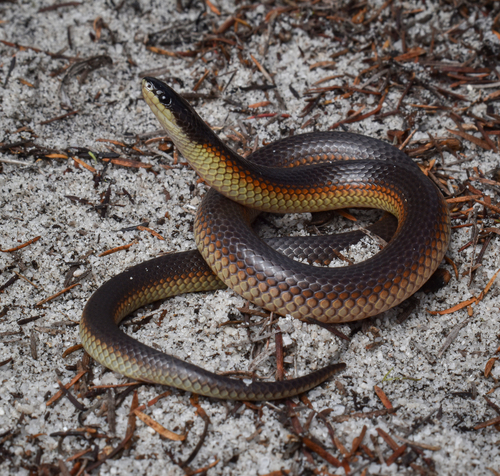
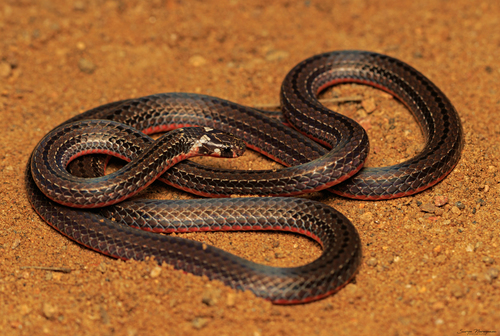
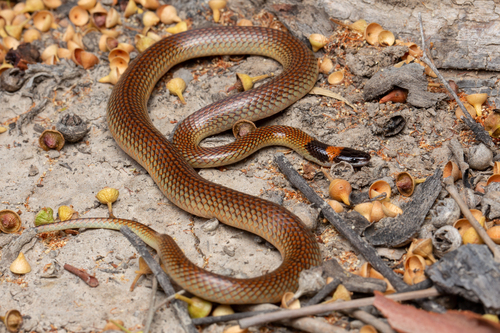
Furina diadema, commonly called the red-naped snake, has small black eyes, a shiny black head and neck. Its head is partially flattened, with a white streak along the upper lip.
Neck Patch Morphology
The back of the neck features a distinct, well-defined orange or red patch shaped like a diamond, crescent, or oval.
Body and Belly Coloration
The snake's belly is either cream or white, and the rest of its body is red-brown. The edges of the dorsal scales are black or dark brown, giving the body a net-like patterned appearance.
Body Size Characteristics
This species has a slim body and is classified as a small snake. Reported maximum total lengths vary between sources: one notes 45 cm, while another gives a maximum of 40 cm, and males are smaller than females.
Scale Count Details
Red-naped snakes have 160 to 210 ventral scales, a divided anal scale, 35 to 70 subcaudal scales, and typically 15 rows of mid-body scales.
General Habitat Range
The red-naped snake is a terrestrial species that occurs across eastern Australia, in dry woodlands, forests, coastal forests, heaths, tussock grasslands and shrublands. It typically avoids wet habitats such as rainforests.
Shelter Microhabitats
This snake shelters under rocks and fallen timber, inside ant or termite nests, under wood piles, leaf litter, old sheets of iron, in rock crevices and abandoned animal burrows.
Australian State Distribution
The red-naped snake is found across four Australian states (Victoria, New South Wales, Queensland, South Australia) and the Northern Territory. It occurs in areas ranging from arid to humid, extending from Port Augusta in South Australia to Cairns in northern Queensland.
Documented Sighting Locations
Documented locations where the species has been sighted include the Coongie Lakes Ramsar Site in South Australia; Woomargama National Park and Mullengandra in the NSW Murray Catchment; the Lower Murray Darling basin in New South Wales; the area around Alice Springs in the Northern Territory; and far north-western Victoria in riverine areas, per Museum of Victoria records. The species is also present in 18 national parks across Queensland.
Reproductive Mode
The red-naped snake is oviparous, meaning it lays eggs.
Clutch Size Variation
Clutch size records vary, with recorded ranges including 2–5, 1–10, 3–6, 1–5, and a single recorded clutch of 8 eggs, with an average clutch size of 3. In subtropical regions, red-naped snakes can produce more than one clutch per year.
Egg Hatching Timeline
Eggs hatch in January in most regions, and in February in cooler areas.
Hatchling Characteristics
Recorded lengths of newly hatched snakes are 12 cm (4.7 in) and 15 cm (5.9 in). Red-naped snakes reach adulthood within one year of hatching.