About Fraxinus nigra Marshall
Taxonomic Identification
Black ash (Fraxinus nigra Marshall) is a medium-sized deciduous tree.
Mature Height
It typically reaches 15–20 metres (49–66 ft) tall, and may grow exceptionally up to 26 metres (85 ft) tall.
Trunk Diameter
Its trunk usually grows up to 60 cm (24 inches) in diameter, reaching an exceptional maximum of 160 cm (63 inches).
Bark Characteristics
Even on young trees, the bark is grey, thick and corky, and becomes scaly and fissured as the tree ages.
Winter Bud Features
Black ash winter buds are dark brown to blackish, with a velvety texture.
Leaf Arrangement and Composition
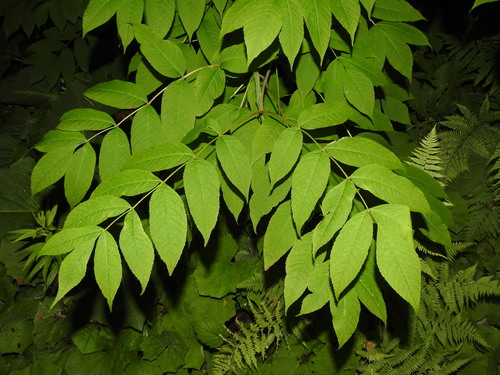
Its leaves are opposite and pinnately compound, bearing 7–13 leaflets, most often 9.
Full Leaf Length
Each full leaf measures 20–45 cm (8–18 in) long.
Leaflet Dimensions
Leaflets are 7–16 cm (2+3⁄4–6+1⁄4 in) long and 2.5–5 cm (1–2 in) broad, with finely toothed margins.
Leaflet Attachment
Leaflets are sessile, attaching directly to the leaf rachis without a separate petiolule.
Flowering Timing
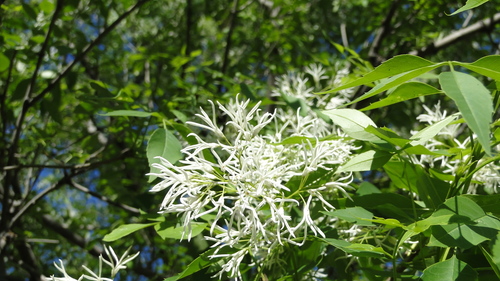
Flowers form in loose panicles in spring, produced shortly before new leaves emerge.
Flower Traits and Pollination
They are inconspicuous, lack petals, and are wind-pollinated.
Fruit Structure and Size
The fruit is a samara 2.5–4.5 cm (1–1+3⁄4 in) long, consisting of a single 2 cm (3⁄4 in) long seed with an elongated apical wing that measures 1.5–2 cm (5⁄8–3⁄4 in) long and 6–8 mm (1⁄4–5⁄16 in) broad.
Common Habitat
Black ash most commonly grows in swamps, and often occurs alongside the closely related green ash.
Fall Foliage and Senescence
Its fall foliage is yellow, and it is one of the first tree species to lose its leaves in autumn.
Taxonomic Relatedness
It is very closely related to Manchurian ash, hybridizes with the species easily, and some botanists classify the two as geographic isolates of a single species.
Pre-invasion Conservation Status
Before the invasive emerald ash borer was first detected in North America in 2002, black ash was considered abundant, and its long-term survival was not seen as a concern.
Emerald Ash Borer Impact
Since 2002, this invasive insect has spread across most of black ash's native range, and the species is expected to be nearly entirely extirpated within a few years; green ash faces a similar fate.
Ash Mortality Estimate
In 2014, a U.S. Forest Service agent estimated that ninety-nine percent of all ashes in North America will probably die.
Impact on Other Ash Species
Blue ash and white ash are only slightly less impacted than black ash and green ash.
Potential Persistent Populations
A small number of populations in the northern part of black ash's range may persist, where winter temperatures drop low enough to kill or substantially reduce local emerald ash borer populations.