About Fraxinus mandshurica Rupr.
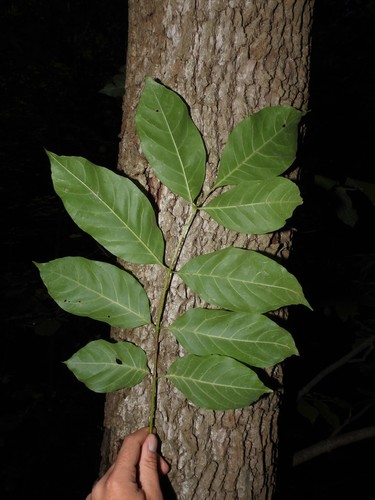
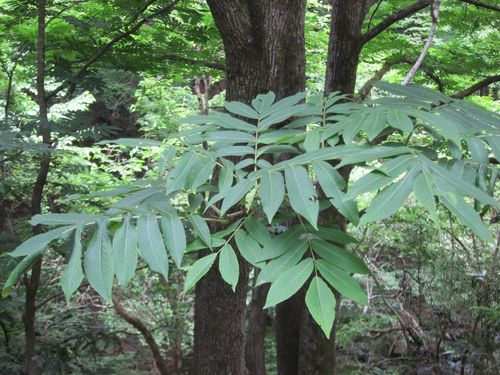
Fraxinus mandshurica Rupr., commonly called Manchurian ash, is a species of Fraxinus that is native to northeastern Asia. Its native range covers northern China (including Gansu, Hebei, Heilongjiang, Henan, Hubei, Jilin, Liaoning, Shaanxi, and Shanxi), Korea, Japan, and southeastern Russia’s Sakhalin Island. This is a medium-sized to large deciduous tree that can reach 30 meters in height, with a trunk that grows up to 50 centimeters in diameter. Its leaves are pinnate compound, measuring 25 to 40 centimeters long overall, and carry 7 to 13 leaflets. Individual leaflets are 5 to 20 centimeters long and 2 to 5 centimeters broad, they are subsessile on the leaf rachis and have serrated margins. The leaves turn golden-yellow in early autumn, and this species typically changes color earlier than many other trees. Manchurian ash produces flowers in early spring, before new leaves emerge, arranged in compact panicles. The flowers are inconspicuous, have no petals, and are pollinated by wind. Its fruit is a samara that holds a single 1 to 2 centimeter long seed, with an elongated apical wing that is 2.5 to 4 centimeters long and 5 to 7 millimeters broad. This species is closely related to Fraxinus nigra, the black ash native to eastern North America, and some authors have classified it as a subspecies or variety of black ash, under the names F. nigra subsp. mandschurica (Rupr.) S.S.Sun or F. nigra var. mandschurica (Rupr.) Lingelsheim. However, unlike black ash, Fraxinus mandshurica is dioecious: it produces male and female flowers on separate individual trees. The spelling of this species’ name is disputed: sources such as the Flora of China use the spelling mandschurica, while sources like the USDA GRIN database use mandshurica. The original 1857 Russian publication spelled the epithet without the letter "c". In terms of ecology, Manchurian ash tolerates a wide range of soil conditions, including the wet soils found in swamps and river valleys. It has no strong preference for soil pH, but grows poorly at high pH levels. It requires full sun to grow optimally, and needs at least 50 centimeters of precipitation annually. It grows best in a continental climate, which has well-defined seasons including cold winters, hot summers, and no late spring frosts. A wide variety of bird species eat the seeds of this tree. Manchurian ash is occasionally cultivated as an ornamental tree in parts of Canada and the United States. It can be used as a medium-height windbreak for farmsteads. It is also highly tolerant of urban pollution and grows well in inner-city environments. It works very well as a landscape tree in moist areas, especially along roads and ditches where ample water is available. With age, Manchurian ash develops a dense, oval growth form. When cultivated, it proves very intolerant of oceanic climate conditions, as it leafs out too early and the new growth is then damaged by late spring frosts. This species is being tested as a potential source of genes for resistance to the emerald ash borer (Agrilus planipennis), an Asian insect that shares the native range of Manchurian ash and has become an invasive pest in North America. However, significant mortality of wild Manchurian ash caused by emerald ash borer has also been recorded in China. A cultivar, Fraxinus mandshurica 'Mancana' (sometimes called Manchana Ash), has been selected by the Morden Research Station in Morden, Manitoba. This is a hardy male clone with a dense oval to globose crown. Hybrids between Manchurian ash and black ash have also been produced in cultivation.