About Fraxinus americana L.
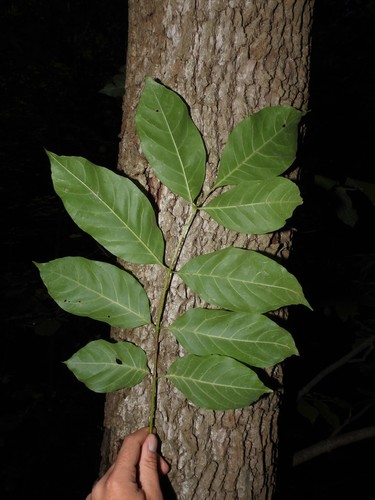
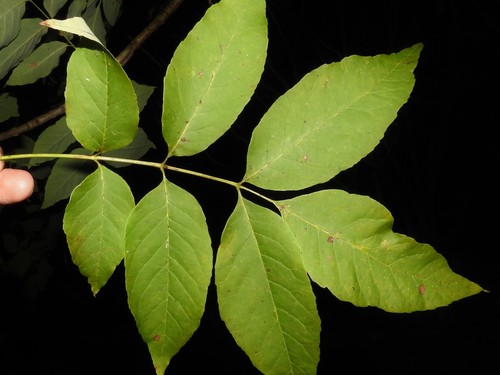
The common name white ash (Fraxinus americana L.) comes from the glaucous, lighter-colored undersides of its leaves. It is similar in appearance to green ash (Fraxinus pennsylvanica), which makes the two species hard to distinguish. White ash twigs may have a flaky or peeling outer surface, while green ash twigs are smoother; green ash leaf upper and lower surfaces are similar in color, unlike white ash’s contrasting leaf sides. White ash also turns yellow or red during autumn. While there is some overlap in ranges, the two species typically grow in different habitats: white ash is a forest tree that commonly grows alongside sugar maple, while green ash is a pioneer species that lives in riparian zones and disturbed areas. White ash’s compound leaves usually have 7 leaflets per leaf, while leaflet counts more often vary among other ash tree species. Like other species in the section Melioides, Fraxinus americana is dioecious, meaning separate individual plants produce male and female flowers. White ash’s C-shaped leaf scars help separate it from the closely related green ash; in green ash, lateral buds form a less curved margin with their corresponding leaf scars, giving leaf scars an overall D shape. This species is native to mesophytic hardwood forests ranging from Nova Scotia west to Minnesota, south to northern Florida, and southwest to eastern Texas. Isolated populations have also been found in western Texas, Wyoming, and Colorado, and the species is reported to be naturalized in Hawaii. An estimated 8 billion ash trees grow in the United States, the majority of which are white ash and green ash. White ash is one of the most commonly utilized trees for everyday purposes, and it is cultivated almost wherever possible to meet high demand. Its wood is white, quite dense (within 20% of 670 kg/m³), strong, and straight-grained. The species grows an ideal, atypical dominant excurrent structured crown. White ash is a traditional timber of choice for making baseball bats and tool handles, and its wood is also well suited for furniture and flooring. In one study comparing it to eight other species, white ash showed the highest antibacterial activity for use in manufacturing chopping boards. Woodworkers mainly use this timber for interior projects because it perishes easily when in contact with ground soil. It is also used to make lobster traps. Since the 1950s, it has also been a popular choice for solid electric guitar bodies. When properly worked, it can make a serviceable longbow. From the 1970s through the mid-1980s, it was used for ceiling fan blades, though cane was sometimes simulated with plastic during that period. It is no longer used for ceiling fan blades in most countries. White ash is not as common in cultivation as green ash, because it prefers undisturbed forest sites away from urban pollution and soil compaction. It is sometimes planted for its reliably consistent autumn colors, which are typically bright orange and red, unlike the uniform yellow autumn color produced by other ash species. White ash cultivation practices differ across the North American continent. For example, 2010 statistics for the Chicago region show white ash is the most common street tree species, making up 6.2% of street trees. When combined with green ash, which ranks third at 4.9%, ashes account for 11% of the city’s street trees, and Cook County alone holds an overall standing ash population of 13,648,044 million trees. The cultivar 'Autumn Purple', also called 'Junginger' after Karl Junginger of McKay Nursery, was introduced to the plant trade in 1956. Though Junginger is credited with discovering this seedless cultivar that displays strong reddish-purple autumn color, the University of Wisconsin records that it was first spotted by G. William Longenecker in front of the old Home Economics building, and Longenecker made the first graft of this tree in 1955. It quickly became the most popular and most expensive landscaping selection, surpassing the already high-priced ginkgo, London plane, and white/burr oak. A related tree, Biltmore ash, is sometimes classified as a variety of white ash, while other taxonomists argue it is a separate species, Fraxinus biltmoreana. North American native ash tree species are a critical food source for North American frogs, because fallen ash leaves are particularly suitable for tadpoles to feed on in ponds (both temporary and permanent), large puddles, and other water bodies. Due to emerald ash borer damage, red maple and other species are replacing ash in North American forests. These replacement species, such as red maple, produce leaves much less suitable as food for frogs, which leads to poor frog survival rates and smaller adult frog sizes. The low tannin content of American ash leaves makes them a good food source for frogs, but North American ash varieties are not resistant to the ash borer. Non-native ash varieties from outside North America typically have much higher tannin levels and are resistant to the ash borer. Maples and various non-native invasive trees that are replacing native American ash in the North American ecosystem generally have much higher leaf tannin levels. Native North American ash species also provide important habitat and food for many other native North American creatures.