About Fratercula corniculata (J.F.Naumann, 1821)
Adult Size
Adult horned puffins (Fratercula corniculata) are approximately 20 cm (8 in) tall, weigh around 500 g (18 oz), and have a wingspan of about 58 cm (23 in).
Sexual Monomorphism
The species is monomorphic, meaning males and females have identical plumage coloration.
Facial Horn Feature
Sexually mature individuals have a small fleshy black "horn" that extends upward from the eye, which gives the species its common name.
Breeding Season Facial Markings
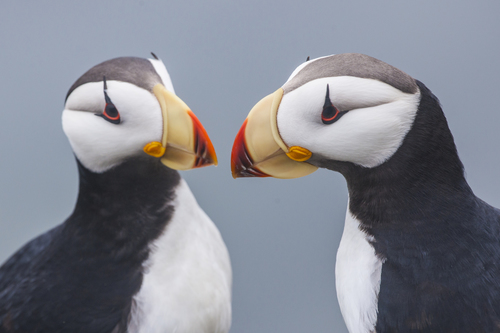
A dark eyestripe runs backward from the eye toward the back of the head, the cheeks are white, and there is a yellow wattle at the base of the bill.
Limb Color
Legs and feet are orange.
Bill Base Characteristics
The horned puffin's bill is larger than the bills of other puffin species, red at the tip and yellow at the base.
Breeding Season Bill Changes
During the summer breeding season, the outer layer of the bill, called the rhamphotheca, grows larger and turns bright yellow with a dark orange tip.
Rhamphotheca Mating Function
The size and color of this layer helps individuals attract mates.
Non-Breeding Plumage
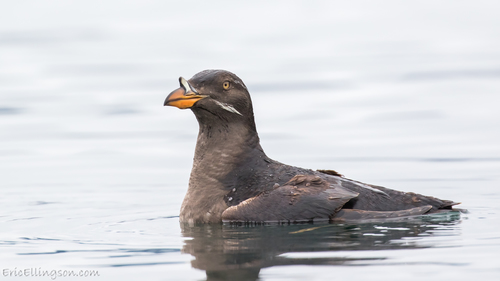
After the breeding season ends in late summer, the bright outer rhamphotheca is shed, the face plumage changes to gray and black, and the legs and feet fade to a pale fleshy color; this non-breeding plumage is called eclipse plumage.
Fluorescent Bill Courtship Use
The bill also has fluorescent properties that are used to attract partners, and horned puffins can see ultraviolet rays, which allows them to detect this luminescence during courtship.
Chick Appearance
Horned puffin chicks have smoky-gray cheeks, a fine, black triangular beak, and pinkish or greyish feet.
Juvenile Size At Fledging
Juveniles are smaller than adults when they leave the nest.
First Year Facial Change
Young puffins lose their greyish facial markings during their first spring.
Beak Development Timeline
The beak develops its full shape by one year of age, and continues to grow over time, reaching its brightest coloration when individuals reach sexual maturity at five years old.
Adult Maturity Age
Horned puffins reach their full adult size and weight by the age of five.
Range Abundance
The horned puffin is relatively common across its native range.
Pacific Range Distribution
It occurs throughout the northern Pacific Ocean, including the Shumagin Islands of the Bering Sea, the Siberian coast, Kamchatka, Sakhalin, and the Kuril Islands.
North American Range
In North America, it is found along the western coasts of Alaska and British Columbia, Haida Gwaii and the Aleutian Islands.
Chukchi Sea Range
It is also found near the Chukchi Sea, particularly on Wrangel Island.
Vagrant Range
More rarely, individual horned puffins travel as far south as Japan, and the coasts of Oregon and California.
Movement Patterns
The species is not migratory, though it spends the winter far out at sea.
Nesting Habitat
Horned puffins live on steep rocky slopes and cliffs.
Nest Site Preference
Unlike other puffin species, they dig little to no burrows, and instead prefer to nest and shelter in rock crevices or spaces under rock piles.
Washington Range Observation
As of 2023, at least one horned puffin has been observed spending summer months on Smith Island, Washington, in the Salish Sea, alongside the local breeding population of tufted puffins.
Range Expansion Research
With assistance from regional commercial whale watching companies, researchers are working to determine if this is a lone individual or a mated pair.
Potential New Breeding Site
If it is a mated pair, this location would be a new breeding site for the species hundreds of miles outside its normal range.
Breeding Age And Timing
Horned puffins reach sexual maturity between five and seven years of age, and breed between May and September.
Pair Monogamy
Breeding pairs are monogamous.
Courtship Initiation
Courtship begins when a male and female swim alongside each other on the water.
Male Courtship Display
The male displays by rising from the water with his neck outstretched, opening and closing his bill while jerking his head.
Female Courtship Response
The female responds by holding a hunched posture with her neck tucked in close to the water surface.
Billing Behavior
This is followed by billing, a behavior where mated individuals touch beaks.
Pair Bond Confirmation
A small head movement from both partners confirms the pair will mate for life.
Mating Behavior
The male then mounts the female from behind, beating his wings to maintain balance.
Post-Mating Behavior
After approximately 35 seconds of mating, the female dives underwater before resurfacing, and both members of the pair then flap their wings.
Nest Site Selection Timing
One week after arriving at the breeding area, pairs select a nesting site, preferring rock crevices.
Nest Construction
They clear a space and collect grass and feathers to build their nest.
Clutch Size
Each breeding pair lays only one egg per year.
Egg Laying Synchrony
Pairs in the same colony typically lay their eggs around the same time, and rarely does laying extend over more than one week.
Female Reproductive Adaptation
Sperm storage glands in the female's oviduct aid in sperm selection for fertilization.
Egg Appearance
The egg is oval-shaped, off-white with lavender, gray, and brown markings.
Incubation And Chick Rearing Period
Both parents take turns incubating the egg for around 41 days, then spend another 40 days raising the chick.
Fledging Behavior
When the chick is ready to fledge, it leaves the nest alone at night, travels to open water, then dives and swims away to begin an independent life.
Climate Impact On Reproduction
Rising ocean temperatures have increased the reproductive rate of the horned puffin.
Adult Diet
Adult horned puffins have a generalist diet, feeding on fish, small invertebrates, crustaceans, polychaete worms, and squid.
Plant Food Sources
They also eat small algae and marine plants.
Foraging Depth
To catch fish, horned puffins dive to depths of around 30 meters (98 ft), though most hunting takes place at 15 meters (49 ft).
Foraging Timing
They most often hunt in the early morning.
Dive Hunting Process
They dive head-first into the water, watch for a school of fish while also keeping an eye out for predators, then dive after prey once spotted.
Dive Duration
Hunting dives usually last between 20 and 30 seconds.
Prey Handling Behavior
Puffins usually swallow several small fish before bringing any remaining prey back to the colony, and do not adjust the position of prey in their beak to avoid losing their catch.
Foraging Location
Hunting areas are typically located fairly far offshore from the puffins' nesting site.
Prey Transport Adaptation
Horned puffins return from hunts carrying several small fish, squid, or crustaceans held in their specialized bills.
Chick Diet
Chicks have a less varied diet, feeding mainly on sandeel or capelin caught near the coast.
Chick Feeding Frequency
Parents deliver these fish to chicks two to six times per day.
Chick Feeding Method
Unlike many other seabirds that feed their young by regurgitation, horned puffins feed their chicks whole fish directly from the bill.
Parental Rearing Participation
Both parents participate in feeding and rearing the chick.