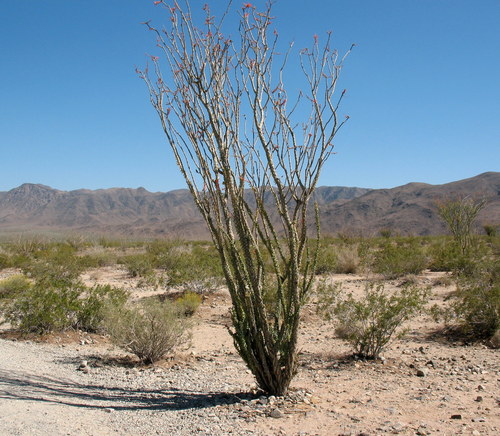
About Fouquieria splendens Engelm.
Taxon and Habitat
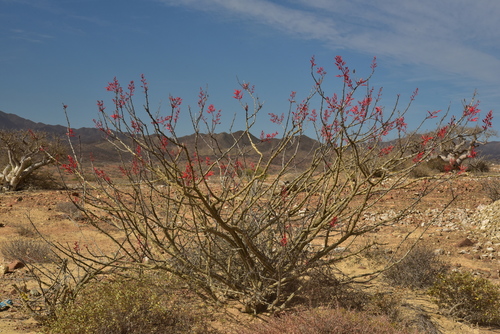
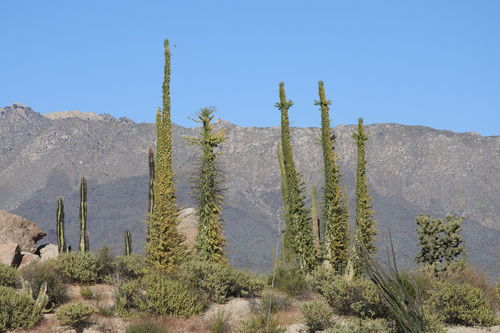
Botanical characteristics: Fouquieria splendens Engelm. (ocotillo) grows in dry, generally rocky desert soils.
Maturity and Height
Ocotillo reaches maturity between 60 and 100 years of age, and grows to a maximum height of 10–15 feet (3.0–4.6 m).
Branch Structure
It forms a clump of 40–75 straight, slender greenish branches covered with thorns; each stem may reach a diameter of 6 cm at its base.
Bark and Leaf Morphology
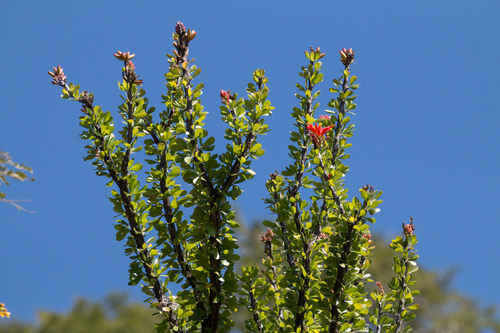
The branches have rough bark, and produce small, ovate leaves 2–4 cm long directly from their sides.
Leaf Growth Response
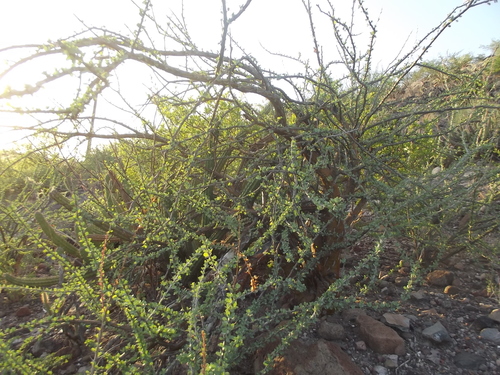
After rainfall, the plant quickly grows lush with new leaves, which may remain for weeks or even months.
Cultivated Branch Development
Cultivated specimens may not develop any secondary branches.
Spine and Leaf Regrowth
Leaf stalks harden into blunt spines, and new leaves sprout from the base of each spine.
Flowering Timing and Arrangement
Bright crimson flowers grow on mature plants especially after rainfall in spring, summer, and occasionally fall; they are clustered indeterminately at the tips of each stem.
Flower Morphology and Pollination
Individual flowers are mildly zygomorphic, and are pollinated by hummingbirds and native carpenter bees.
Flower Longevity
The flowers last between one and a half to 2 months.
Planting Timing
Cultivation: Ocotillo can be planted year-round with proper care.
Ideal Cultivation Stock
Ideal cultivated plants are grown in pots from stem cuttings and from seed.
Bare-Root Transplant Success
Transplanting large bare-root plants has only marginal success.
Transplanting Depth and Orientation
Plants should be planted at the same depth they originally grew at, and like cacti, placed in their original directional orientation: the original south side of the plant, which has developed greater resistance to heat and sunlight, should again face the brighter, hotter southern direction.
Unmarked Transplant Risk
If the original direction is not marked, transplant success is limited.
Fencing Use
Uses: In ocotillo's native region, individual stems are sometimes used as poles for fencing material, and often take root to form a living fence.
Cane and Walking Stick Use
Due to their light weight and interesting pattern, ocotillo branches have been used for canes or walking sticks.
Edible Flower Use
Fresh flowers are sometimes used in salads and have a tangy flavor.
Tisane Flower Use
Flowers are collected and dried for use in tisanes.
Tincture Preparation
According to Medicinal Plants of the Desert and Canyon West, a 1989 book published by Museum of New Mexico Press, a fresh bark tincture can be made by chopping or snipping freshly removed bark into 1/2-inch pieces.
Tincture Fluid Congestion Use
This tincture is said to be useful for symptoms arising from fluid congestion, and to be absorbed from the intestines into the mesenteric lymph system via the lacteals of the small intestinal lining.
Tincture Lymph and Fat Absorption Use
It is believed to stimulate better visceral lymph drainage into the thoracic duct and improve dietary fat absorption into the lymph system.
Fatigue Relief Bath Use
Bathing in water infused with crushed flowers or roots has been used to relieve fatigue.
Wound Treatment Use
Native Americans place ocotillo flowers and roots over fresh wounds to slow bleeding.
Additional Medicinal Uses
Ocotillo is also used to alleviate coughing, achy limbs, varicose veins, urinary tract infections, cervical varicosities, and benign prostate growths.