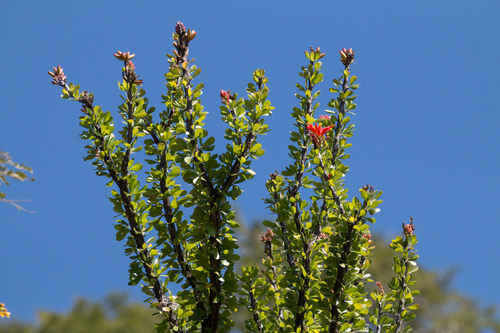
About Fouquieria formosa Kunth
Fouquieria formosa Kunth is a small tree that reaches 8 meters in height, and its flowers are pollinated by hummingbirds.
Avian and Bee Visitors
Perching birds can also use its flowers, while carpenter bees and bumblebees are likely common visitors.
Nectar Robbing Traces
These bees often leave characteristic small transverse cuts on the corolla tube from their nectar robbing habit.
Pollination Mechanism
Because the species' stamens and stigma protrude significantly from the flower tube, insect visitors do not likely affect pollination.
Morphology
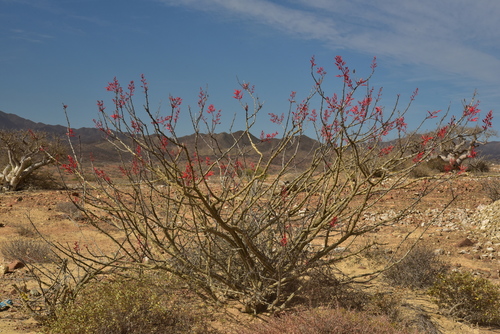
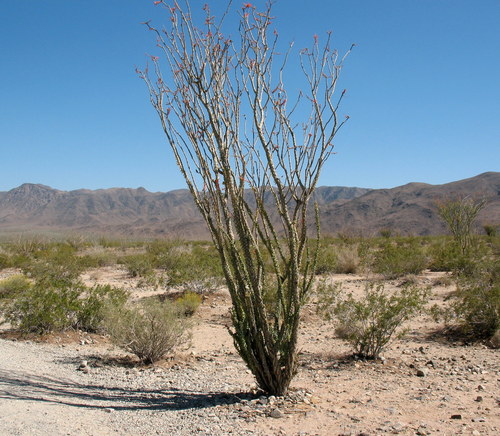
Morphologically, it grows as a small tree 3 to 8 meters high, with 1 to 2 basal trunks that measure 25 to 40 cm in diameter.
Stem Structure
Larger stems branch dichotomously, and bear numerous erect to widely spreading young stems.
Periderm Features
The plant's periderm is smooth, colored dark bronze to yellow, and exfoliates in thin, papery sheets.
Stem Coloration
Larger stems and trunks are often green.
Spine Variation
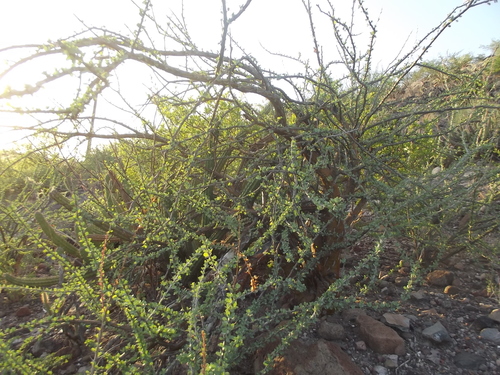
Branches are covered in spines that vary in length between populations, ranging from as short as 4 mm to as long as 20 mm; some populations may almost lack spines entirely.
Inflorescence and Flower Color
It produces short, spicate inflorescences holding large flowers that range in color from deep orange-red to yellow-orange.
Flower Morphology
These flowers have decurved corollas and a variable number of stamens.
Phenotypic Plasticity
This species has a high level of phenotypic variation across its range, and variations in spine length and stamen number are not consistent within individual plants, indicating environmental influences on these traits.
Distribution and habitat
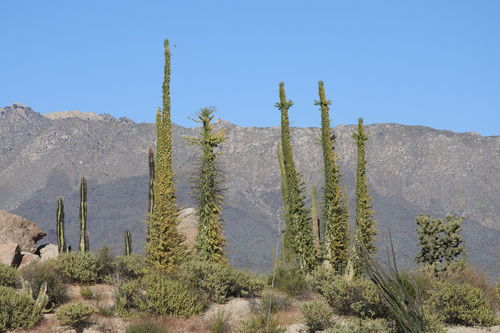
In terms of distribution and habitat, this plant grows on rocky alluvial slopes and valleys in lateritic to calcareous soils, ranging from Jalisco to southeastern Oaxaca.
Vegetation and Elevation Range
It occurs in vegetation types from tropical deciduous forest to arid tropical scrub, at elevations between 700 and 2400 meters, and reaches as low as 100 meters near Tehuantepec in Oaxaca.
Rainfall Pattern
In its native range, most average annual precipitation falls between June and September.
Flowering Period
Flowering typically occurs from October through February, but can also happen year-round.
Environmental Trait Variation
Local environmental conditions induce trait variation based on where plants grow.
Arid Region Morphotypes
In arid regions of Puebla and Oaxaca, plants of this species tend to have glabrous stems, long spines, short flowers, and a relatively medium to high number of stamens.
Highland Region Morphotypes
In moist highlands of Morelos and Mexico State, plants have short spines and a relatively medium to low number of stamens.