About Foeniculum vulgare Mill.
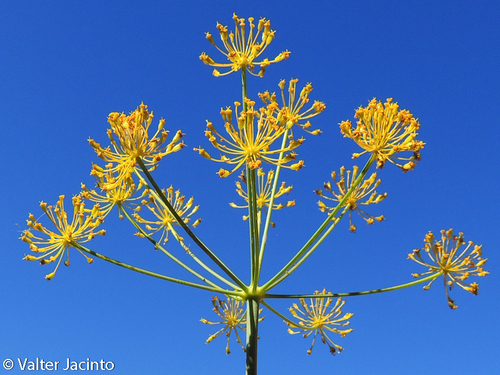
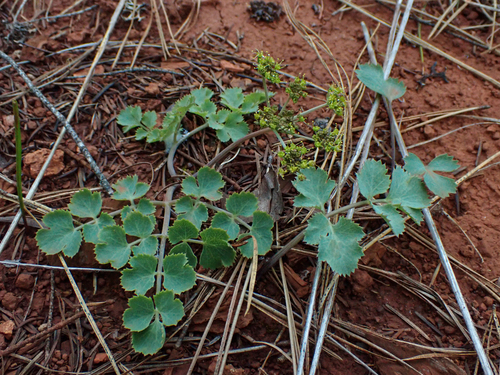
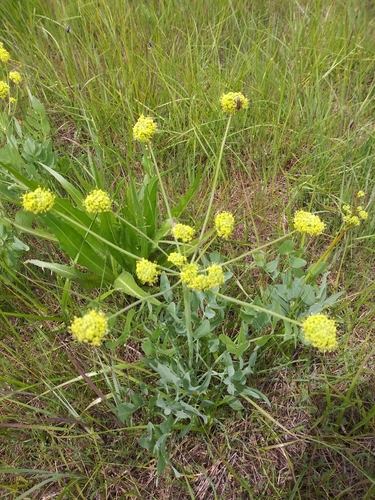
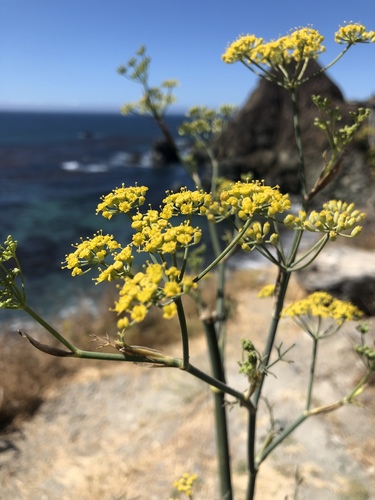
Foeniculum vulgare, commonly known as fennel, is a perennial herb. It has a hollow, erect, glaucous green stem that can grow up to 2.1 meters (7 feet) tall. Its leaves reach up to 40 centimeters (16 inches) long, are finely dissected, and have thread-like ultimate segments around 0.5 millimeters (1⁄64 inch) wide. Fennel leaves resemble those of dill, but are thinner. Fennel produces flowers in terminal compound umbels that are 5 to 17.5 cm (2 to 7 in) wide. Each section of the umbel holds 20 to 50 tiny yellow flowers on short pedicels. Its fruit is a dry schizocarp, 4 to 10 mm (3⁄16–3⁄8 in) long, half as wide or less, and grooved. Fennel is widely cultivated within its native range and in other regions for its edible, strongly flavored leaves and fruits. Its aniseed or licorice flavor comes from anethole, an aromatic compound also found in anise and star anise; fennel’s taste and aroma are similar to these, though usually less strong. Florence fennel belongs to the Foeniculum vulgare Azoricum Group (synonym F. vulgare var. azoricum), a cultivar group with inflated leaf bases that form a bulb-like structure. This cultivar group is of cultivated origin, has a mild anise-like flavor that is sweeter and more aromatic than standard fennel, and plants are smaller than the wild type. Several Florence fennel cultivars are known by other names, most notably the Italian name finocchio. In North American supermarkets, Florence fennel is often mislabeled as "anise." Foeniculum vulgare 'Purpureum' (also called 'Nigra'), known as bronze-leaved fennel, is widely available as a decorative garden plant. Fennel has become naturalized along roadsides, in pastures, and in other open sites across many regions, including northern Europe, the United States, southern Canada, and most of Asia and Australia. It propagates easily from both root crowns and seed, and is classified as an invasive species and a weed in Australia and the United States. It can drastically change the composition and structure of many plant communities, including grasslands, coastal scrub, riparian, and wetland communities. It does this by outcompeting native species for light, nutrients, and water, and possibly by releasing allelopathic substances that inhibit the growth of other plants. In western North America, fennel grows from the coastal and inland wildland–urban interface east into hill and mountain areas, and is not found in desert habitats. For example, on Santa Cruz Island, California, fennel reaches an absolute cover of 50 to 90%. Ancient Greeks and Romans valued fennel, using it as medicine, food, and insect repellent. Fennel tea was thought to give courage to warriors before battle. Emperor Charlemagne mandated that fennel be cultivated on all imperial farms. Florence fennel is one of the three main herbs used to make absinthe, an alcoholic mixture that originated as a medicinal elixir in Europe, and became a popular alcoholic drink in France and other countries by the late 19th century. Fennel fruit is a common traditional spice used to flavor Scandinavian brännvin, a loosely defined group of distilled spirits that includes akvavit. Fennel is also documented in 16th-century Chinese Materia Medica for use in traditional Chinese medicine. A 2016 study found that F. vulgare essential oil has insecticidal properties.