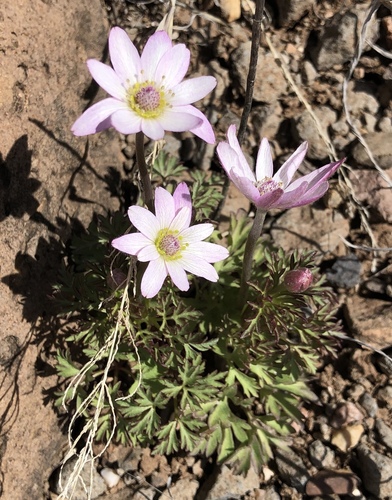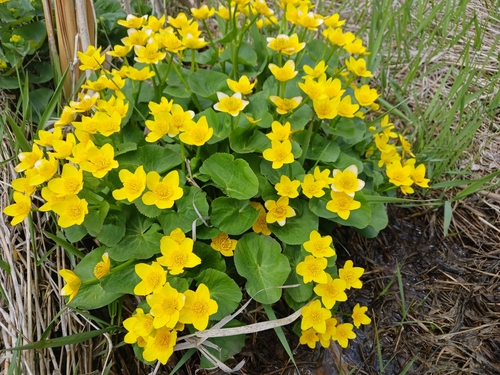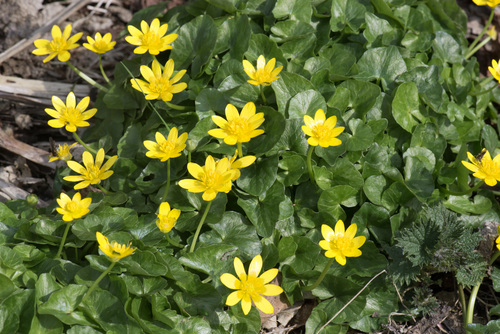
About Ficaria verna Huds.
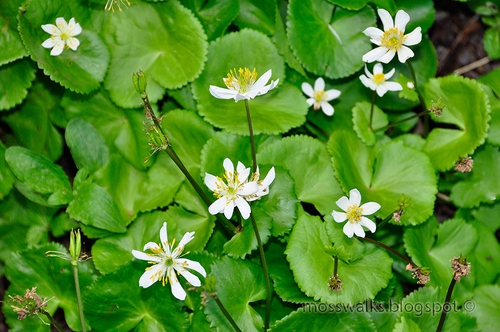
Ficaria verna Huds., commonly called lesser celandine, is a hairless perennial plant that grows to about 25 cm (9.8 in) tall, forming clumps of 4 to 10 short stems. Leaves are arranged spirally on the stems or all grow from the plant’s base. Leaf stalks have sheathing bases, no stipules, a groove along their upper surface, and two internal hollows. Leaves are cordate (heart-shaped), 1–4 cm (0.39–1.57 in) across, dark green on the upper surface with a distinctive variegated or mottled pattern, and pale green on the lower surface. Purple-leaved varieties are common. Leaf margins are sometimes entire (rounded), but more often angled or weakly lobed, with hydathodes at the lobe tips. The plant has two root types: dense clusters of thick, pale-colored elongated tubers, surrounded by patches of short fibrous roots. Some clumps produce long stolons reaching 10 cm (3.9 in) or more, which allow vegetative spread that forms extensive carpets of plants. Lesser celandine produces large radially symmetrical (actinomorphic) flowers up to 3–5 cm (1.2–2.0 in) in diameter. Flowers grow on long stalks that arise individually from leaf axils, or are arranged in loose cymes at the top of stems. There are no bracts. Flowers have a whorl of 3 sepaloid tepals, and 7 to 12 glossy yellow petaloid tepals that are sometimes tinged purple or grey on their back. Double-flowered varieties also occur. Stamens and carpels are numerous. The fruit is a single-seeded, shortly hairy achene with a very short style. In several subspecies, tubers form in leaf axils after flowering. In the UK, it blooms between March and May. Ficaria verna sensu lato is native to central Europe, north Africa, and the Caucasus. It has been introduced to Iceland and North America. Lesser celandine grows on seasonally wet or flooded land, especially in sandy soils, and does not grow in permanently waterlogged sites. It can grow in both shaded woodlands and open areas, and begins growth in winter when temperatures are low and days are short. The plant mostly propagates and spreads via vegetative reproduction, though some subspecies can produce up to 73 seeds per flower. Seed germination begins in spring and continues into summer. Seedlings stay small in their first year, only producing one or two leaves before the second year. Growth and reproduction are poor in dry or acidic conditions, though the plants tolerate drought well when dormant. By emerging before the forest canopy leafs out, Ficaria verna can take advantage of higher sunlight levels reaching the forest floor in late winter and early spring. By late spring, second-year plants age quickly as daylight hours lengthen and temperatures rise. By the end of May, foliage has died back and the plant enters a six-month dormancy phase. If disturbed, separation of the plant’s numerous basal tubers is an efficient method of vegetative propagation. The prolific tubers are easily spread when they are unearthed and scattered by digging activities of animals and humans. Erosion and flood events are particularly effective for spreading the plant, as it successfully colonizes low-lying floodplains once tubers are deposited there. Ficaria verna occurs in both diploid (2n=16) and tetraploid (2n=32) forms that are very similar in appearance. Tetraploid types prefer shadier locations and can develop up to 24 bulbils at the base of the stalk. Tetraploid subspecies include F. verna ssp. verna and F. verna ssp. ficariiformis; they can colonize new areas much faster because they produce bulbils in their leaf axils in addition to root tubers. Subspecies F. verna calthifolia and F. verna verna are diploid, and hybrids between subspecies often produce sterile triploid forms. Lesser celandine is pollinated by bees, small beetles, and flies, including Apis mellifera, Bibio johannis, Phora, and Meligethes. The larvae of Olindia schumacherana feed on its leaves. It forms associations with arbuscular mycorrhizal fungi. All plants in the buttercup family (Ranunculaceae), including Ficaria verna, contain the compound protoanemonin. When the plant is wounded, the unstable glucoside ranunculin converts to the toxin protoanemonin. Contact with damaged or crushed Ficaria leaves can cause itching, rashes, or blistering on the skin or mucous membranes. Ingesting the toxin can cause nausea, vomiting, dizziness, spasms, or paralysis. One recorded case describes a patient developing acute hepatitis and jaundice after taking untreated lesser celandine extracts internally as an herbal remedy for hemorrhoids. Some herbalists call the plant pilewort, because it has historically been used to treat piles (hemorrhoids). It is still recommended in several current herbal guides for treating hemorrhoids, by applying an ointment made of raw leaves mixed into a cream or lanolin to the affected area. The plant’s knobby tubers are said to resemble piles, and per the doctrine of signatures, this resemblance suggests pilewort can be used to cure piles. Nicholas Culpepper (1616–1654) is claimed to have treated his daughter for scrofula (King’s evil) with the plant. The German common name skorbutkraut (“scurvy herb”) comes from the historical use of its young leaves, which are high in vitamin C, to prevent scurvy. However, this use of lesser celandine for scurvy prevention could be considered a misnomer, tied to its similar appearance to common scurvygrass (Cochlearia officinalis), which shares similarly shaped leaves and also shares the German name skorbutkraut. The 1900 German Hager's Manual of pharmacy practice notes that Ranunculus ficaria [sic] and C. officinalis both share this name and this use, though there was little documentation of the toxicity of untreated Ficaria species at that time. Most modern guides note that medicines should be made from the dried herb or prepared via heat extraction, because untreated plants and extracts contain the mild toxin protoanemonin. The plant has been widely used in Russia, and is sold in most Russian pharmacies as a dried herb. Protoanemonin from fresh leaves is an irritant and mildly toxic, but is suggested to have antibacterial properties when used externally. Heating or drying converts the Ranunculaceae toxin protoanemonin to anemonin, which is non-toxic and may have antispasmodic and analgesic properties. Mesolithic hunter-gatherers in Europe consumed the plant’s roots as a source of carbohydrates, after boiling, frying, or roasting them.