About Felis manul Pallas, 1776
This description covers the characteristics, distribution and habitat, behaviour and ecology, and reproduction and life cycle of Pallas's cat (Felis manul Pallas, 1776).
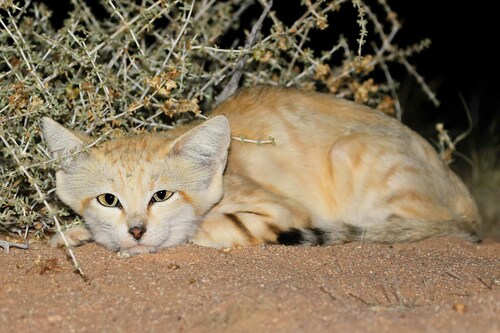
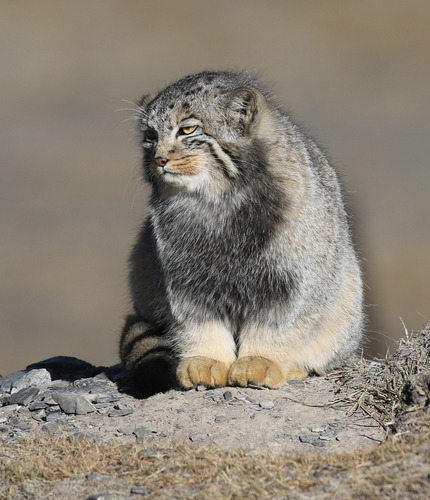
For physical characteristics: Pallas's cat has light grey fur with pale yellowish-ochre or pale yellowish-reddish undertones, with some hair tips white and others blackish. Its fur becomes greyer and denser, with fewer visible markings, in winter than in summer. The forehead and top of the head are light grey with small black spots, and two black zigzag lines run from the corner of the eyes to the jaw joints on the cheeks. The chin, whiskers, and both upper and lower lips are white. There are five to seven narrow black transversal stripes across the lower back. Its grey tail has seven narrow black rings and a black tip. On the back, the underfur is 40 mm (1.6 in) long and 19 μm thick, while guard hairs reach up to 69 mm (2.7 in) long and 93 μm (0.0037 in) thick. Its fur is soft and dense, with up to 9,000 hairs per cm² (58,000 hairs per in²).
Pallas's cat's ears are grey, with a yellowish tinge on the back, a darker rim, and whitish hair in the front and inside the ear pinnae. Its rounded ears are set low on the sides of the head, allowing it to peer over objects while only exposing a small portion of its head above the eyes without lowering its ears, which can give its face a fierce, unconstrained appearance. The eyes are surrounded by white fur, have yellowish irises, and their pupils contract to small circular disks in sunlight; this trait of round pupils is shared with Puma, Herpailurus, and Acinonyx species among the Felinae.
Pallas's cat is roughly the same size as a domestic cat (Felis catus), but its stocky posture combined with long, dense fur makes it appear stout and plush. Head-to-body length ranges from 46 to 65 cm (18 to 26 in), with a 21 to 31 cm (8.3 to 12.2 in) long tail, and body weight ranges from 2.5 to 4.5 kg (5 lb 8 oz to 9 lb 15 oz). It has a stout body, a rounded skull with a short nasal bone, an enlarged cranial section, and rounded zygomatic arches. Its orbits are large and face forward. The legs are short, with short, sharp retractile claws. Male skulls are 87–95 mm (3.4–3.7 in) long and 66–74 mm (2.6–2.9 in) wide at the base; female skulls are 84–96 mm (3.3–3.8 in) long and 65–68 mm (2.6–2.7 in) wide. The lower carnassial teeth are powerful, while the upper carnassials are short and massive. The first pair of upper premolars is absent, giving a dental formula of 3.1.2.1 3.1.2.1 × 2 = 28. It has a bite force of 155.4 newtons at the canine tip, and a bite force quotient of 113.8 at the canine tip. The mitochondrial genome of Pallas's cat is made of 16,672 base pairs, containing 13 protein-coding genes, 22 transfer RNA genes, two ribosomal RNA genes, and one non-coding RNA control region.
For distribution and habitat: Pallas's cat's range extends eastward from the Caucasus to Central Asia, Mongolia, and adjacent parts of Dzungaria and the Tibetan Plateau. It inhabits montane shrublands, grasslands, rocky outcrops, scree slopes, and ravines in areas where continuous snow cover is less than 15–20 cm (6–8 in) deep. In the southwestern part of its range, habitats experience cold, dry winters and moderate to low rainfall in warm summers, with typical vegetation including small shrubs, Artemisia (sagebrush), Festuca, and Stipa grasses. In the central part of its range, it inhabits hilly landscapes, high plateaus, and intermontane valleys covered by dry steppe or semi-desert vegetation such as low shrubs and xerophytic grasses. The continental climate in this region has an overall air temperature range of 80 °C (140 °F), dropping to −50 °C (−58 °F) in winter. The Greater Caucasus region is considered climatically suitable for Pallas's cat.
Specific regional records: In Armenia, an individual was killed near Vedi in the mountains of Ararat Province in the late 1920s, and in January 2020, an individual was sighted around 140 km (90 mi) farther north in Tavush Province, at a habitat transitioning from semi-desert to montane steppe at an elevation of approximately 570 m (1,900 ft). In Azerbaijan, records are limited to one Pallas's cat skin found in Karabakh and a sighting in Julfa District, both in the late 20th century. On the Iranian Plateau, two Pallas's cats were encountered near the Aras River in northwestern Iran before the 1970s; an individual was captured at around 1,500 m (5,000 ft) elevation near Azarshahr in East Azerbaijan Province in 2008, and that same year a camera trap recorded a Pallas's cat on the southern slopes of the central Alborz Mountains in Khojir National Park shortly after heavy snowfall. Farther east in the Alborz Mountains, an individual was recorded among rocks at 2,441 m (8,009 ft) elevation in 2016. Pallas's cat has been recorded in and near protected areas in the Aladagh and Kopet Dag Mountains. In the south of the Zagros Mountains, an individual was caught in a transhumant pastoralist corral in Abadeh County in 2012, in surrounding rocky steppe habitat dominated by mountain almond (Prunus scoparia), Astragalus, and Artemisia.
In Afghanistan, a Pallas's cat was observed sunbathing on the edge of a rocky high-elevation plain near Dasht-e Nawar in the Koh-i-Baba range in April 2007, and it was photographed multiple times in Bamyan Province between 2015 and 2017. In Pakistan, an individual was recorded on a ridge in juniper-dominated forest at 3,445 m (11,302 ft) elevation in Qurumber National Park, Gilgit-Baltistan, in July 2012. In the Transcaspian Region, its presence was first reported in the Kopet Dag mountains and near the Tedzhen and Murghab Rivers in the late 19th century; a camera trap recorded an individual in Turkmenistan's Sünt-Hasardag Nature Reserve in 2019, and it is reported to also be present in Köpetdag Nature Reserve. Historical records exist in the Surxondaryo Region and Gissar Range along the border of Tajikistan and Uzbekistan. In Kyrgyzstan, it is present at high elevations in Sarychat-Ertash State Nature Reserve and in the foothills of the Alay Range; a dead female was found in a valley near Engilchek, Kyrgyzstan, in 2013. In Kazakhstan, it inhabits the highlands and steppes of central and east Kazakhstan, the periphery of the Betpak-Dala Desert, the northern Balkhash District, and the Tarbagatai Mountains. In the South Siberian Mountains, it inhabits grasslands on the Ukok Plateau and in the Altai, Kuray, and Saylyugem Mountains; it is also present in the Chagan-Uzun and Argut river basins, Mongun-Taiga, Uvs Lake Basin, Sayano-Shushenski Nature Reserve, Tunkinsky National Park, Lake Gusinoye basin, and the interfluves of the Selenga, Chikoy, and Khilok rivers. Its presence in the eastern Sayan Mountains was first documented in 1997. In Transbaikal, it inhabits montane steppes at 600–800 m (2,000–2,600 ft) elevation, where annual rainfall ranges from 150 to 400 mm (5.9 to 15.7 in); an individual was observed on the Vitim Plateau in 2013.
In Mongolia, Pallas's cat inhabits the semi-desert steppe of Ikh Nartiin Chuluu Nature Reserve, and prefers rocky, rugged habitats that provide cover and camouflage in Khustain Nuruu National Park and Gobi Gurvansaikhan National Park. On the Tibetan Plateau in western China, two Pallas's cats were observed in an undulating alpine meadow among plateau pika (Ochotona curzoniae) colonies at 4,087 m (13,409 ft) elevation in Qumarlêb County in 2001, and one individual swam across an irrigation channel. An individual was sighted in desert steppe habitat at 5,050 m (16,570 ft) elevation in Gêrzê County in 2005. Pallas's cat was photographed in an alpine meadow in the core area of Sanjiangyuan National Nature Reserve in 2011, and observed at multiple sites in habitats regularly used by pastoralists and their livestock in Ruoergai.
In the Indian Himalayas, Pallas's cat was first reported in Ladakh's upper Indus Valley in 1991. Individuals were sighted near riverbanks at 4,202 m and 4,160 m (13,786 ft and 13,648 ft) elevation in Changthang Wildlife Sanctuary in 2013 and 2015. A Pallas's cat was photographed in rocky alpine scrub at 4,800 m (15,700 ft) elevation in Gangotri National Park in 2019. In Sikkim, an individual was observed on a rocky slope at 5,073 m (16,644 ft) elevation near Tso Lhamo Lake in 2007. Pallas's cat was recorded in September 2024 in the rugged high-elevation rangelands of the Tawang and West Kameng districts of Arunachal Pradesh. Pallas's cat was first recorded in the Nepal Himalayas in December 2012, photographed in alpine pastures at 4,200 m (13,800 ft) and 4,650 m (15,260 ft) elevation in the upper Marshyangdi river valley in Annapurna Conservation Area. Pallas's cat scat was detected at 5,593 m (18,350 ft) elevation in Shey-Phoksundo National Park in 2016, the highest elevation record globally to date. Pallas's cat was first recorded in Bhutan in January 2012, in rolling hills of glacial outwash dominated by alpine steppe vegetation in Wangchuck Centennial National Park; it was also photographed at 4,122 m (13,524 ft) elevation in Jigme Dorji National Park in autumn 2012. In 2019, scat samples from two individuals were found in Sagarmatha National Park, providing the first genetic evidence of Pallas's cat in the eastern Himalayas.
For behaviour and ecology: Pallas's cat is solitary. Among nine captive Pallas's cat kittens observed, only two males scent-marked by spraying urine. Pallas's cat uses caves, rock crevices, and marmot burrows as shelter. Between June 2005 and October 2007, 29 Pallas's cats in central Mongolia were fitted with radio collars, and they used 101 dens during the study period: 39 winter dens, 42 summer dens, and 20 dens for raising kittens. Summer and winter dens usually have one entrance with a diameter of 15.6 to 23.4 cm (6.1 to 9.2 in). Pallas's cats stay in summer dens for 2–21 days, and in winter dens for 2–28 days. Summer and maternal dens are located close to rocky habitats with little direct sunlight, while winter dens are closer to ravines. The home ranges of 16 females range from 7.4 to 125.2 km² (2.9 to 48.3 sq mi), while the home ranges of 9 males range from 20.9 to 207.0 km² (8.1 to 79.9 sq mi) and overlap the ranges of 1 to 4 females, and partially overlap the ranges of other males. Home range size decreases in winter. In an unprotected area of central Mongolia, Pallas's cats are mainly crepuscular between May and August, but active during the day from September to November. Pallas's cats recorded across four study areas in the western Mongolian Altai mountains are also active during the day, but with lower activity frequency at sites where livestock are present.
For reproduction and life cycle: Female Pallas's cats reach sexual maturity at approximately one year of age, and are in estrus for 26 to 42 hours. Gestation lasts 66 to 75 days. A captive male Pallas's cat kept under natural lighting showed increased aggressive and territorial behaviour at the start of the breeding season (which runs from September to December). Its blood contained three times more testosterone than in the non-breeding season, and its ejaculate was more concentrated, with more normally formed sperm and higher sperm motility. In the wild, females give birth to litters of 2 to 6 kittens between late April and late May. Newborn kittens have fuzzy fur, and their eyes remain closed until they are around two weeks old. A newborn male kitten born in a zoo weighed 89 g (3.1 oz), measured 12.3 cm (4.8 in) in head-to-body length, and had a 5.5 cm (2.2 in) long tail. In central Mongolia, seven females with kittens used 20 dens over 4–60 days of observation; maternal dens are either among rocks or in abandoned burrows of the Tarbagan marmot (Marmota sibirica), and have at least two entrances. In Iran, a Pallas's cat was observed using cavities in old Greek juniper (Juniperus excelsa) as a breeding den for a litter of four kittens. Two-month-old kittens weigh 500–600 g (17.6–21.2 oz), and their fur gradually grows longer. Kittens start hunting at around five months old, and reach adult size by 6 to 7 months of age.