About Falco chicquera Daudin, 1800
Species Description
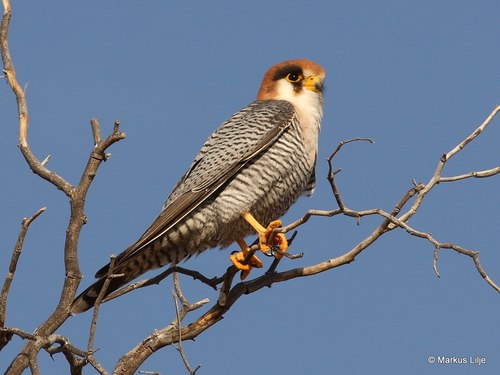
The red-necked falcon (Falco chicquera Daudin, 1800) is a medium-sized, long-winged falcon species that has a bright rufous crown and nape. On average, it measures 30–36 cm (12–14 in) in length, with a wingspan of 85 cm (33 in).
Plumage Features
Its wings and upper parts are bluish grey; the tail has narrow bars, a broad subterminal black band, and is tipped with white. When the bird is at rest, its wingtip does not reach the tip of the tail.
Wing Structure
The second and third primaries are the longest and almost equal in length, while the first primary is one-fourth their length. The first two primaries have notches.
Soft Part Traits
Its legs, ceres, and eyering are yellow. The tip of its bill is black, while the basal portion is greenish yellow.
Vocalization
This species' call is a shrill ki-ki-ki-ki.
Sexual Dimorphism
Males and females have similar plumage, but differ in size: as is typical for falcons, males are smaller than females.
Juvenile Traits
Juvenile red-necked falcons are buff on the underparts, have less extensive barring, and duller upper plumage.
For habitat and distribution
African Habitat
In Africa, the red-necked falcon occurs in semi-desert, savannah, and other dry open country with some trees, and also in riverine forest. It often perches in, and uses the crowns of Borassus palms (Borassus aethiopum) for breeding.
Movement Patterns
Most individuals are resident, but may make nomadic movements in response to weather conditions.
Indian Habitat
In India, the species lives in open habitats, and does not occur in dense forests or high hills.
Western Range History
The nominate subspecies is thought to formerly ranged west as far as Iran, though no records of it there exist after 1970; breeding was recorded there in 1911 by Nikolai Zarudny.
Sri Lanka Records
It is a winter vagrant in northern Sri Lanka, where it was first recorded by E.L. Layard.