About Faidherbia albida (Delile) A.Chev.
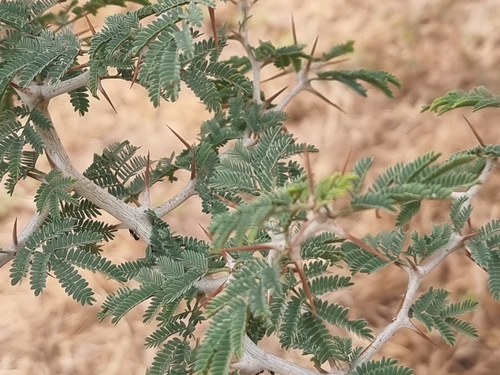
Faidherbia albida (Delile) A.Chev. is a thorny tree that reaches 6–30 m (20–98 ft) in height, with a trunk diameter of up to 2 m (6+1⁄2 ft). Its deep-penetrating tap root gives it high drought resistance. Mature bark is grey and fissured, and this species produces approximately 11,000 seeds per kilogram.
In Southern Africa, it is absent from most territory, and avoids dry, colder, upland, and winter rainfall areas. It occurs in the eastern Caprivi Strip, the northern Okavango basin, the floodplains of the Linyanti, Zambezi, and Limpopo rivers, and extends south to Gaborone. In Zimbabwe, it is absent from the highlands and central plateau, and occurs in Gonarezhou, extending south to Kruger Park and the adjacent lowveld of western Gaza and southern Maputo provinces. Its southernmost distribution limit is along the Pongola floodplain in Maputaland. In western Namibia, it is present in Kaokoveld, Damaraland, and the Namib-Naukluft area.
Across the rest of Africa, it is absent from deserts, high rainfall areas, tropical rainforests, and mountainous areas. It occurs throughout the eastern half of the continent from the southern coast of Maputaland north to Egypt, and across the Subsaharan Sahel and the Horn of Africa. In Northern Africa, it occurs in both Egypt and Algeria, is not found in Morocco proper, but is present in Western Sahara. In Asia, it is considered native to Yemen and Saudi Arabia on the Arabian Peninsula, Iran, and the Levantine countries of Israel, Syria, and Lebanon. In Israel, the species is protected by law, with relict groves located in the Shimron nature reserve, near the community settlement of Timrat, and in the westernmost reaches of the Valley of Elah. All trees within each of these groves are genetically identical, and appear to have reproduced only via vegetative reproduction for thousands of years. Introduced populations of Faidherbia albida exist in Cyprus, Pakistan, Karnataka (India), and on Ascension Island.
In Southern Africa, Faidherbia albida most commonly grows on alluvial floodplains in bushveld, along riverbanks, on flood pans, in swamps, or in dry watercourses that flood during rainy seasons. It grows in woodland in the Sahel, along the Zambezi, and in Sudan. In the Sahel, it grows in dense, distinct groves. It also grows in savannahs in Sudan and the Sahel, in heavy, well-drained soils. In tropical eastern Africa, it sometimes grows as isolated individual trees, but is often the dominant species in dry woodlands. In the Sahel, it has an irregular, clumped distribution, being absent from some areas and present in others. It grows in regions that receive 250–600 mm (10–23+1⁄2 in) of rain per year.
Faidherbia albida is an important species for beekeeping in the Sahel, because its flowers provide forage for bees at the end of the rainy season, when most other local plants have finished flowering. Its seed pods are used for livestock rearing: they serve as camel fodder in Nigeria, and are eaten by domestic livestock and game in Southern Africa. The pods are favored by elephants, antelopes, buffalo, baboons, and a variety of other browsers and grazers, but are notably ignored by warthogs and zebras. The wood is used to make canoes, mortars, and pestles, and pounded bark from this tree is used as packing material on pack animals in Nigeria. At 12% water content, the wood has a density of approximately 560 kg/m3, and an energy value of 19.741 kJ/kg when used as fuel. Wood ash from the species is used in soap making, and as a depilatory and tanning agent for hides. The wood is also used for carving, and thorny branches are used as a natural barbed fence. Pods and foliage are widely considered high-quality livestock fodder. Approximately 90% of Senegalese farmers interviewed by Felker in 1981 collected, stored, and rationed Acacia albida pods for livestock. Zimbabweans use the pods to sedate fish, and local people in Zimbabwe eat the boiled seeds during periods of food scarcity.
It is valued in agroforestry because it fixes nitrogen, and test plots of maize grown interspersed with these trees at densities from 25 to 100 trees per hectare have produced high yields. According to a 2018 article in The Guardian, monocultures of this species, called gao in Hausa, are popular for intercropping in parts of Niger. It is also used for erosion control. A key benefit as an agroforestry tree is that it sheds its leaves during the rainy season, so it does not compete with crops for sunlight. Its use in farmer-managed natural regeneration of degraded soils across southern Niger since the 1990s has been described as "the biggest positive environmental transformation in the Sahel, and possibly in Africa".
For medicinal use, an extract of the tree is used to treat ocular infections in farm animals. The bark is used in traditional medicine in Southern Africa and Niger.