About Eutaxia myrtifolia (Sm.) R.Br.
Growth Form
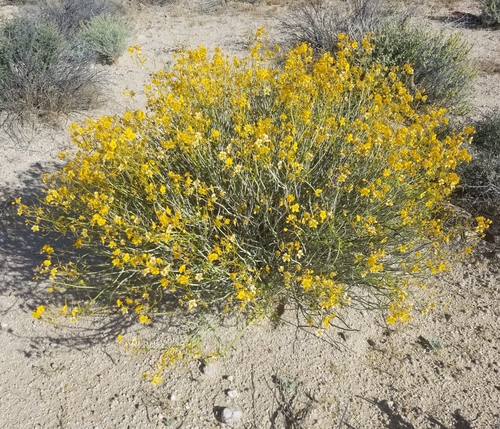
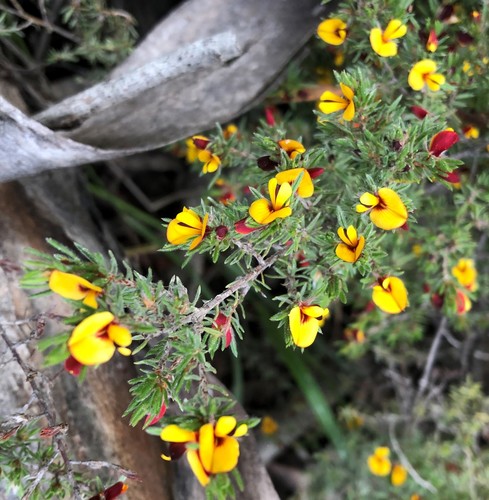
Eutaxia myrtifolia (Sm.) R.Br. is a shrub that can take two main growth forms: a scrambling, prostrate habit reaching around 2 metres in both height and width, or a spindly, broom-like appearance with terete, glabrous stems.
Phylloclade Characteristics
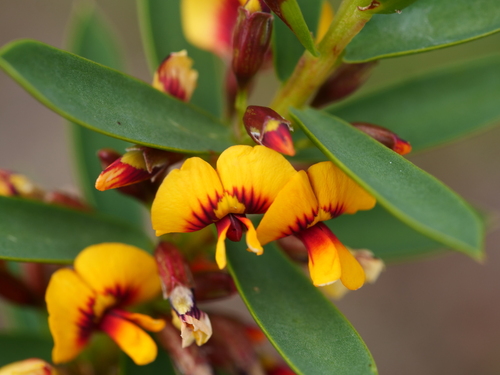
Its flat, evergreen, glabrous phylloclades (or leaves) are arranged oppositely, measure 2.5 to 10 millimetres long and 2 to 5 millimetres wide, and have either flat or recurved margins. Stipules may be absent, or present and persisting on older leaves.
Flower Morphology
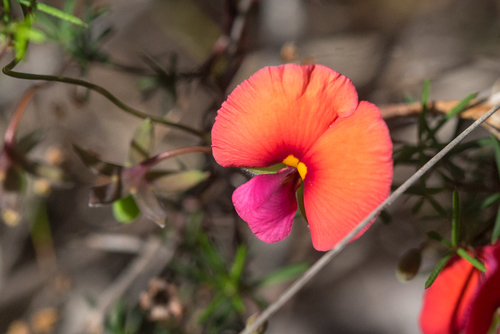
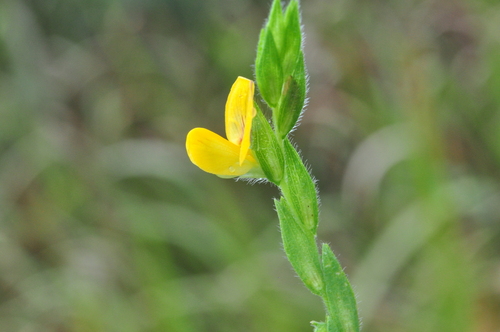
Flowers are attached to glabrous pedicels that are 4 to 5 millimetres long, and display colours ranging from yellow and orange to red.
Flowering Period
Their flowering period runs from May to July through to January or February.
Natural Habitat
This species grows in mossy areas, along watercourses, in swampy locations, and among rocky outcrops, in peaty sand or sandy clay loam soils over granite or quartzite.
Natural Distribution
It is found along the south west and south coast of Western Australia, from Busselton in the north west to around Esperance in the south east.
Cultivation Synonyms
In cultivation, this species has a reputation as a reliable shrub, and has often been known under the synonyms Dillwynia obovata or Eutaxia obovata.
Cultivation Growing Conditions
It grows well in rockeries, containers, and any other situation that provides good drainage. It tolerates mild frosts, and can be grown in coastal areas with some protection.
Cultivation Pruning
Pruning after flowering encourages more compact growth.
Cultivated Size
Cultivated specimens usually grow between 0.75 and 1 metre high, with a slightly smaller width.
Propagation Methods
Plants can be propagated from cuttings or from scarified seed.