About Eurycea lucifuga Rafinesque, 1822
Taxonomy and Size
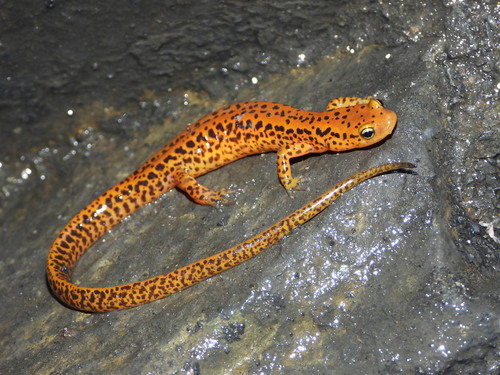
The cave salamander, Eurycea lucifuga Rafinesque, 1822, is a relatively large lungless salamander, with a total length ranging from 10 to 20 cm (4 to 8 in). Its tail makes up 60–65% of the animal’s total length, a significant proportion of the full body size.
Coloration and Markings
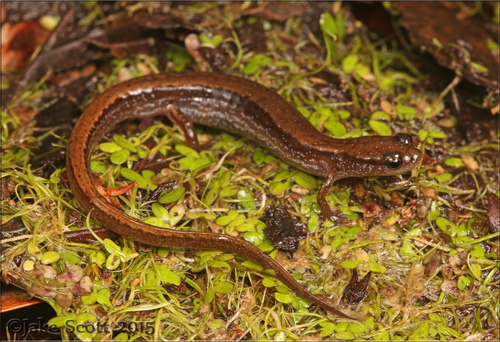
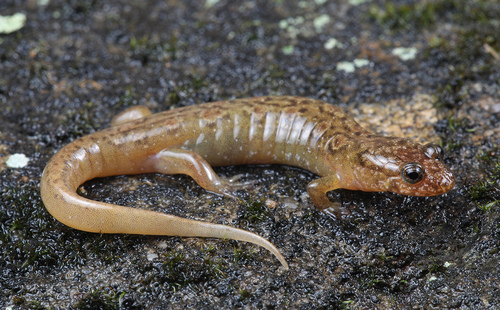
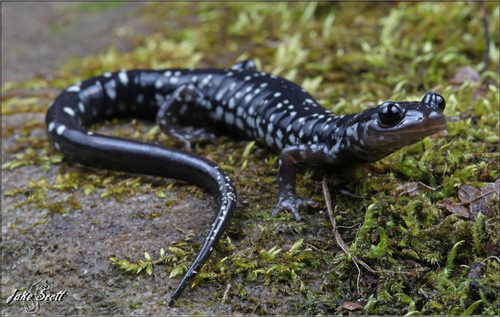
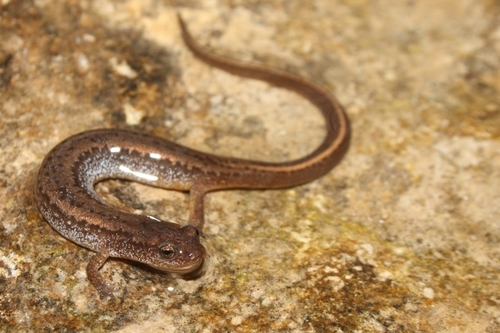
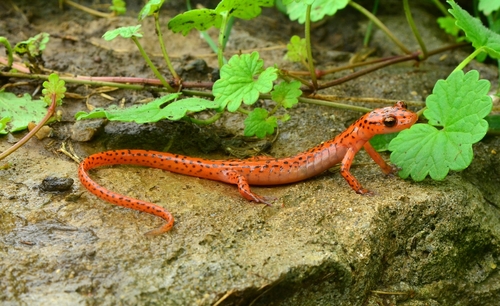
Post-metamorphic individuals have orange to reddish orange upper backs, an unmarked pale ventral surface, and a dorsal surface heavily covered in irregularly spaced spots and dashes.
Body Morphology
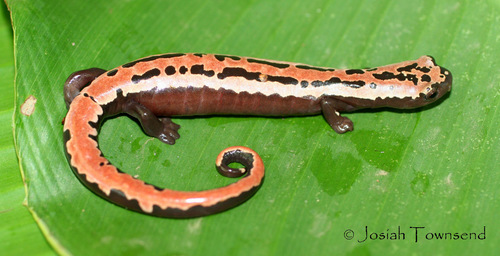
This species has long limbs, 14–15 costal grooves along the side of the body, and a prehensile tail.
Typical Habitat
Cave salamanders typically live in areas with exposed limestone or other calcareous rock, most often in crevices of rock faces, bluffs, and caves. This species is frequently found hundreds of meters from cave mouths, far past the cave’s twilight zone.
Non-Cave Habitat
Despite its common name, the cave salamander is not restricted to caves; it can also be found in forests near bluffs and rocky crevices, around springs, and under moist rocks and logs.
Geographic Range
This species occurs in Alabama, Arkansas, Illinois, Missouri, Kentucky, Virginia, West Virginia, Oklahoma, Tennessee, Kansas, Indiana, and Ohio.
Mating Season
The courtship and mating season of the cave salamander is not well documented, but available data indicates it takes place in summer, continuing into early autumn.
Courtship Behavior
Observations from a pair kept in captivity show that this species’ courtship is similar to that of the Northern two-lined salamander: the male nudges and rubs his chin on the female’s head and snout, may do push-ups with his hind legs, and then positions the base of his tail under the female. If the female is receptive, she will straddle the male’s tail as they walk together, while the male arches his back.
Spermatophore Transfer
The male deposits a 4 mm tall spermatophore on the ground in the female’s path, which the female picks up with her cloaca.
Egg-Laying Period
After mating, females have a prolonged egg-laying period that runs from September to February.
Egg Location
Very few cave salamander eggs have been found by biologists, which suggests females choose hard-to-access locations such as springs, streams, and rim stone pools deep within caves and crevices. In Missouri, eggs have been found laid singly or attached to the sides of rimstone pools, on silt deposits, or on the bottom of small pools.
Egg Characteristics
Freshly laid eggs are white, with two jelly membranes surrounding the embryo. Egg diameter ranges from 2.5 to 3.2 mm, and females can produce between 5 and 120 eggs per clutch.
Larval Habitat
Larval cave salamanders look similar to other larval Eurycea, and have been found in both surface streams and cave streams and pools. Researchers think larvae found in surface streams may have been washed out of caves and crevices by heavy rains.
Larval Diet
Larval cave salamanders are predators that feed primarily on benthic invertebrates including snails, ostracods, copepods, isopods, mayflies, stoneflies, beetles, and flies; ostracods, snails, and fly larvae are the most common items in their diet.
Larval Feeding Behavior
Larvae capture prey by slowly crawling over the substrate, grasping the invertebrate with their mouth, and swallowing it whole, so prey size is limited by the larva’s gape.
Metamorphosis Period
The period from hatching to metamorphosis into a terrestrial adult lasts between 6 and 18 months, and this length varies by region. By the time of metamorphosis, larvae can reach a total size of 70 mm, with a 33 mm snout-to-vent length.