About Euphlyctis hexadactylus (Lesson, 1834)
Description Attribution
This description of Euphlyctis hexadactylus (Lesson, 1834) is reproduced from Boulenger.
Vomerine Teeth Structure
Vomerine teeth are arranged in two oblique series that extend beyond the hinder edge of the choanae.
Head Morphology
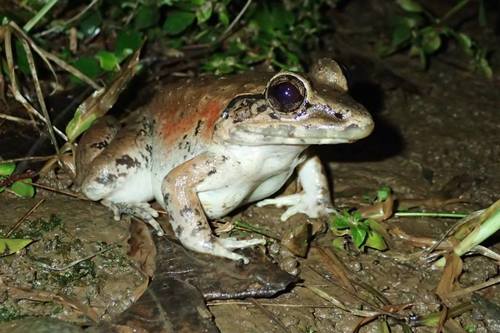
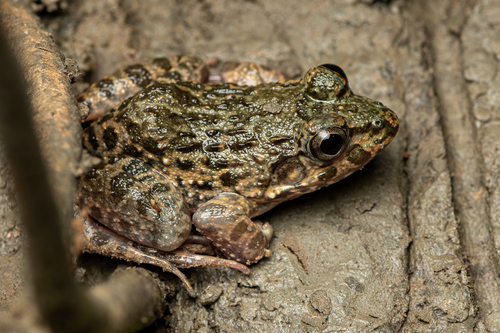
The head is moderate in size; the snout is rather pointed; canthus rostralis is indistinct; the interorbital space is much narrower than the upper eyelid; the tympanum is distinct, and matches the size of the eye.
Finger Structure
Fingers are slender with acutely pointed tips, and the first finger extends a little beyond the second.
Toe Structure
Toes are webbed all the way to their acutely pointed tips; the outer toe has a strong fringe; the fourth toe is not very much longer than either the third or fifth.
Tubercle Morphology
Subarticular tubercles of the fingers and toes are very small; the inner metatarsal tubercle is small and conical, and no outer tubercle is present.
Hind Limb Proportion
When the hind limb is brought forward along the body, the tibio-tarsal articulation reaches the eye.
Skin Texture
The skin is smooth, with more or less distinct rows of pores around the neck, sides, and belly.
Dorsal Coloration
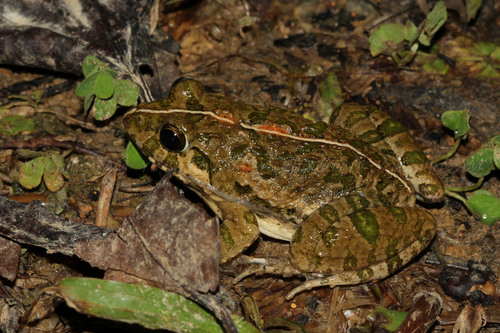
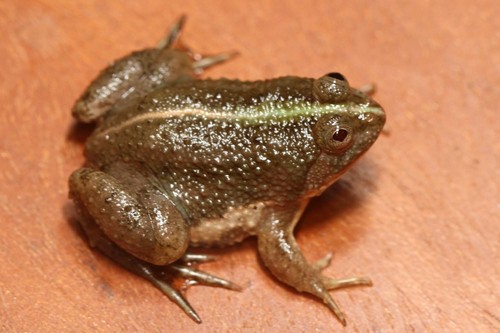
The dorsal surface is brown; a light vertebral stripe is sometimes present.
Thigh Markings
Two blackish streaks appear on the hinder side of the thighs, and these are sometimes indistinct.
Juvenile Coloration
Young individuals are beautifully striped.
Male Secondary Sexual Characteristics
Males have two external vocal vesicles that open through two slits beneath the angles of the mouth.
Habitat Type
Euphlyctis hexadactylus is a largely aquatic species that lives in most types of water bodies.
Brackish Water Record
It has even been recorded in brackish water in Sri Lanka.