About Eubucco bourcierii (Lafresnaye, 1845)
Weight of non-occidentalis subspecies
For the red-headed barbet Eubucco bourcierii, male individuals from all subspecies except E. b. occidentalis weigh between 30 to 41 g (1.1 to 1.4 oz), while females from all subspecies except E. b. occidentalis weigh between 31 to 38 g (1.1 to 1.3 oz).
Weight of E. b. occidentalis subspecies
Male E. b. occidentalis weigh 37.8 to 45.1 g (1.33 to 1.59 oz), and female E. b. occidentalis weigh 37.8 to 43.7 g (1.33 to 1.54 oz).
Male general plumage
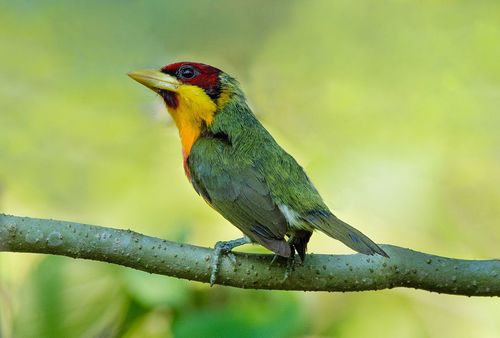
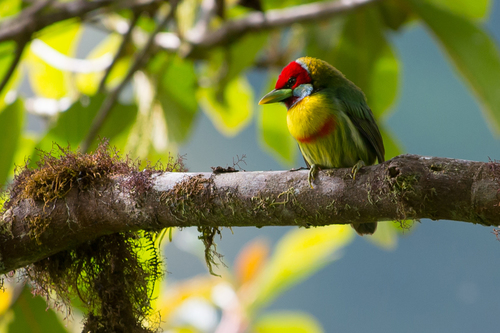
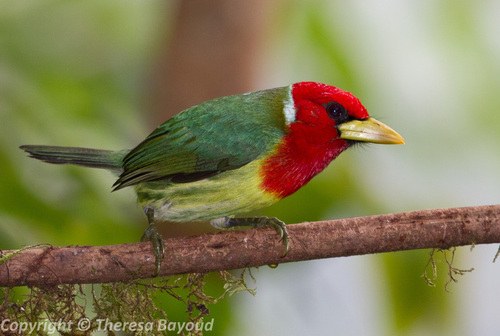
Males have a red head, an orange to yellow breast, and a white belly. A white collar separates the head from the olive green back.
Male plumage variation
The extent of red on the throat and chest and the width of the orange-yellow breast band differ between subspecies.
Female crown and nape variation
Among subspecies, the female’s crown and nape ranges from dull orange to various shades of green. Several subspecies have a black forehead.
Female general plumage
Females have a green back, a grayish yellow throat, with a yellow to orange band below the throat. Their lower breast is olive-yellow and the belly is white.
Female plumage variation
Like males, females also show some variation across subspecies.
Subspecies distributions
The species’ subspecies have the following documented distributions: E. b. salvini is found in Costa Rica and western Panama; E. b. anomalus is found in eastern Panama and probably in adjacent northwestern Colombia; E. b. occidentalis is found on both slopes of the Western Andes in Colombia; E. b. bourcierii is found in the Andes of western Venezuela, the east slope of Colombia's Central Andes, and both slopes of Colombia's Eastern Andes; E. b. aequatorialis is found in coastal mountains and the western slope of the Andes in Ecuador; E. b. orientalis is found on the eastern slope of the Andes in Ecuador and northern Peru.
Habitat
The red-headed barbet lives in the interior and edges of evergreen mountain primary forest, and also in adjacent secondary forest.
Elevational range
The species has an overall elevational range of 400 to 2,400 m (1,300 to 7,900 ft), though there is substantial geographic variation in this range.