About Capito hypoleucus Salvin, 1897
Taxonomic Context and Size Comparison
After the taxonomic division of the toucan barbet, the white-mantled barbet (Capito hypoleucus Salvin, 1897) is likely the largest species of New World barbets, with only the scarlet-banded barbet reaching a comparable size.
Standard Measurements
This species has an average length of 19 cm (7.5 in); males weigh an average of 74.6 g (2.63 oz), while females weigh an average of 67.4 g (2.38 oz).
Upperpart Plumage
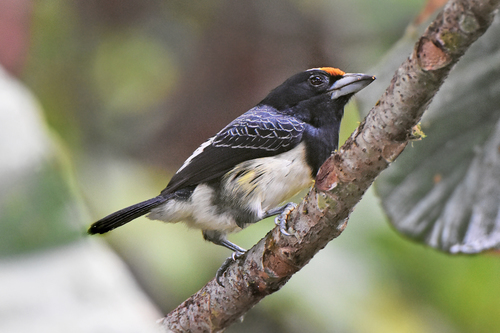
The bird has black upperparts marked with narrow pale lines on the nape and scapulars. These lines are difficult to observe because the species is most often seen high in the canopy of tall trees.
Head and Underpart Coloration
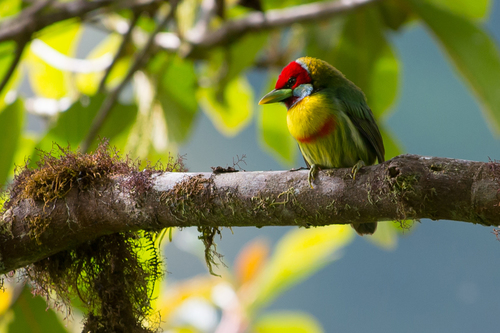
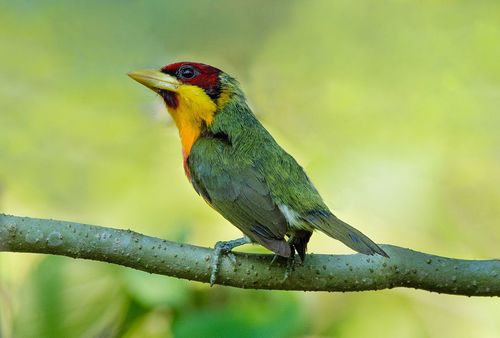
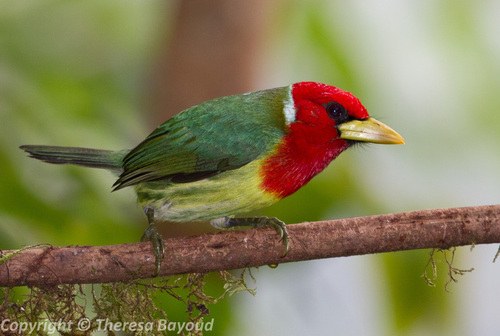
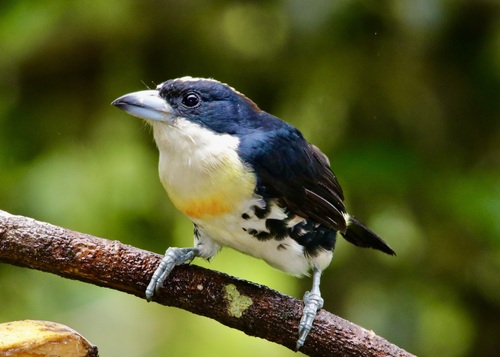
Its forehead and crown are red. Its underparts are white with a faint yellowish tint, and a cinnamon flush on the breast.
Soft Part and Limb Coloration
The eyes are red, the large chunky bill is yellowish, and the legs and feet are greenish-grey.
Female Sexual Dimorphism
Females have a distinct black spot at the base of the lower mandible.
Geographic Range
The white-mantled barbet is found in the Middle Magdalena Valley of Colombia, at altitudes between 200 and 1,800 m (660 and 5,910 ft).
Habitat Preferences
It lives in the tropical zone, where it inhabits humid forests on montane slopes, forest patches set within a mosaic of pastures, secondary forest, and plantations that include mixed fruiting trees.
Foraging Behavior
These barbets usually forage in pairs or family groups, and may join mixed-species feeding flocks. They mostly remain in the forest canopy, but will descend to open areas at fruiting trees such as mango and Cecropia.
Population Trend
The white-mantled barbet population is declining, primarily driven by habitat loss.
Global Conservation Status
The IUCN Red List classifies this species as Vulnerable.
National Conservation Status
The Red Book of the Birds of Colombia lists the species as Endangered, noting that it has lost 60% of its historic habitat, and that habitat loss continues to occur.
Habitat Loss Drivers
The main causes of this habitat loss are illicit cultivation, overuse of insecticides, and small-scale gold mining.