About Erythranthe michiganensis (Pennell) G.L.Nesom
Growth Form
Erythranthe michiganensis (Pennell) G.L.Nesom is an aquatic or semi-aquatic plant that grows in mat-like clumps of decumbent stems, reaching up to 36 centimeters in length.
Stems root at nodes that touch wet substrate, and produce new stems from these rooted points.
Many clumps that hold hundreds of stems can all belong to a single genetic individual.
Leaf Structure
Its leaves are arranged oppositely and have toothed edges.
Flower Arrangement
Flowers develop from leaf axils, and each flower grows on a pedicel that is often longer than the leaves themselves.
Flower Appearance
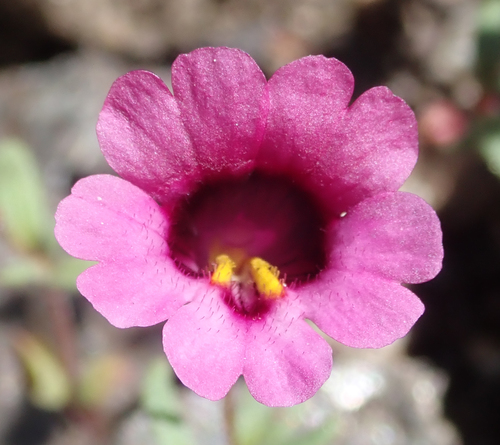
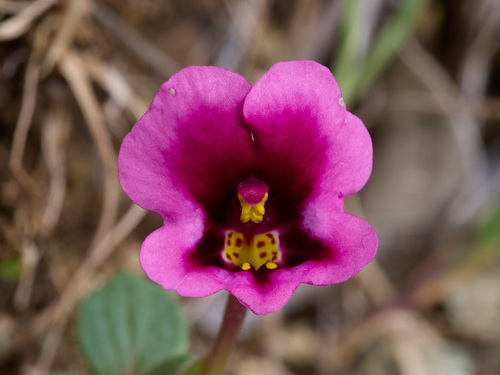
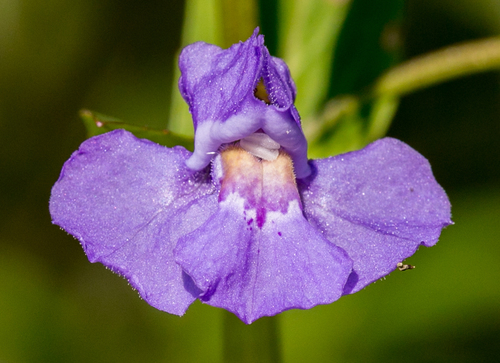
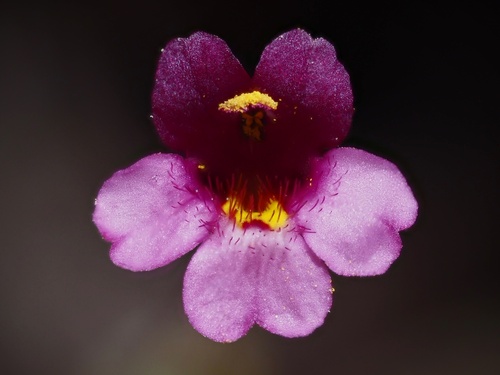
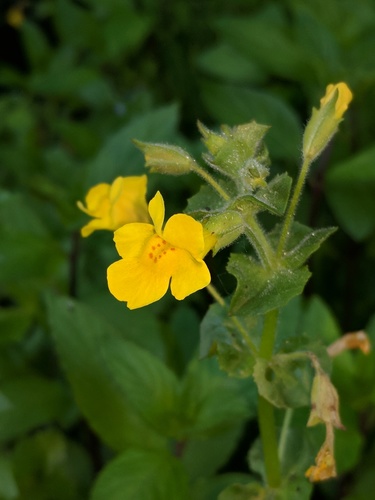
The tubular yellow flower measures 1.6 to 2.7 centimeters long, with a wide mouth that has two lobes on the upper lip and three lobes on the lower lip.
The lower lip and throat of the flower may be speckled with red, and the lower lip is covered in yellow hairs.
Reproduction
This lower lip acts as a landing spot for pollinating insects, but the plant produces very little viable pollen, so most of its reproduction is thought to be vegetative via stolons rather than sexual via seeds.
Dispersal occurs when pieces of the plant break off and float downstream.
Blooming Period
Its blooming period runs from mid-June through mid-July, and sometimes extends into August, and more rarely into September or October.
Distribution Range
Erythranthe michiganensis occurs almost exclusively on the shores of the Great Lakes (specifically Lake Michigan and Lake Huron) or on ancient Great Lakes shorelines.
Habitat Type
It grows on lakesides and stream banks in wet, saturated soil or in very shallow water.
It requires cold, clear flowing water and full sunlight.
Substrate Composition
It grows in substrate made of sand covered with muck, often with calcium compounds beneath the sand layer.
It also appears to require a narrow, slightly alkaline pH range.
Habitat Vegetation Context
Its typical habitat is on the edges of forests dominated by northern white cedar (Thuja occidentalis).
Associated Plant Species
Associated plant species in its habitat include orange touch-me-not (Impatiens capensis), water forget-me-not (Myosotis scorpioides), watercress (Nasturtium officinale), wild mint (Mentha arvensis), and marsh marigold (Caltha palustris).
Known Occurrences
There are 17 known occurrences of this species, though two of these have not been observed recently.
The largest occurrences are at Glen Lake, Burt Lake, and the Mackinac County shoreline.
It can also be found in Sleeping Bear Dunes National Lakeshore.
Land Ownership of Occurrences
Many of the known occurrences are located on privately owned land.
Unusual Discovery Record
One population was discovered after a biologist identified the species as a garnish on his restaurant plate.
Resilience Traits
This species has shown occasional resilience: it has been observed to persist through dry conditions, and after being mowed when it appeared in a residential lawn.
It can also survive without sunlight in darker forest understories, though it grows in a sterile form in these locations.