About Mimulus ringens L.
Nomenclature and Common Names
Mimulus ringens L. is a species of monkeyflower, commonly known as Allegheny monkeyflower and square-stemmed monkeyflower.
Native and Introduced Range
It is native to eastern and central North America, and has been introduced to the Pacific Northwest.
Habitat and Cultivation Availability
It grows in a wide range of moist to wet habitat types, and its seeds are available from commercial suppliers.
Growth Form and Stem Characteristics
This is a rhizomatous perennial herb that grows between 20 centimeters (7.9 inches) and well over 1 meter (3.3 feet) tall, with a typically erect 4-angled stem.
Leaf Arrangement and Morphology
Its leaves are arranged oppositely, are lance-shaped to oblong, reach up to 8 centimeters (3.1 inches) long, and usually clasp the stem.
Species Distinction via Leaf Traits
The sessile (stalkless) leaves of M. ringens help distinguish it from its eastern relative, Mimulus alatus, which has leaves that grow on petioles (stalks) and a winged stem.
Foliage Texture
All above-ground plant parts of M. ringens are hairless.
Flower Structure
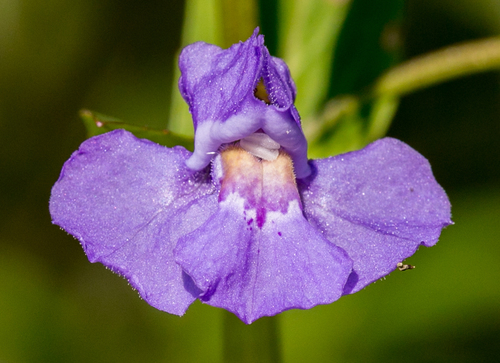
Its flowers are 2.5 to 7.6 centimeters (1 to 3 inches) long, with a tubular base enclosed in a ribbed calyx of sepals with pointed lobes.
Flower Color and Lip Morphology
The flower can be lavender, blue, red, or pink, and is split into an upper lip and a larger, swollen lower lip.